
➤Summary
Dark web monitoring has become increasingly relevant following the Pokémon Center data breach affecting customers in the United Kingdom and Germany. The incident was linked not to a compromise of Pokémon Center’s own website, but to a cyberattack against CEVA Logistics, a third-party fulfilment partner. The exposure reportedly involved customer contact and order information, creating risks that extend beyond the original supply-chain incident.
For security teams, the incident is a useful example of how third-party compromise can create downstream exposure even when an organization’s primary website remains unaffected. It also demonstrates why organizations need visibility into leaked information after a breach, rather than relying solely on perimeter and endpoint controls.
What Happened in the Pokémon Center Data Breach?
Pokémon Center began notifying customers after CEVA Logistics informed the retailer that it had suffered a cyberattack affecting systems involved in fulfilment operations.
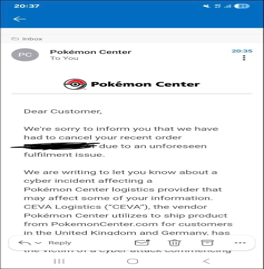
According to reporting published on August 18, 2026, the activity reportedly began on July 30, 2026. Pokémon Center stated that its own website was not the source of the compromise.
The affected fulfilment environment contained information required to process and deliver Pokémon Center orders. As a result, the incident also disrupted fulfilment, with some pending orders cancelled.
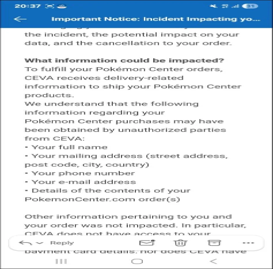
The reported exposure is significant because logistics providers routinely process information that can connect a customer to a physical delivery location. In this case, Pokémon Center said potentially affected information included:
- Full names
- Postal addresses
- Telephone numbers
- Email addresses
- Details about the contents of Pokémon Center orders
Reporting also indicates that payment-card information was not accessible to CEVA and that other Pokémon Center account information was not affected.
Pokémon’s current UK privacy notice confirms that Pokémon Center transactions involve customer and order information and that third-party service providers can process personal information for services provided on Pokémon’s behalf.
Why This Supply-Chain Breach Matters to UK Businesses
The Pokémon Center incident illustrates a familiar supply-chain security problem: an organization can maintain strong controls over its own infrastructure while still being exposed through a trusted provider.
A logistics provider may have access to customer names, delivery addresses, contact details, order identifiers and operational information. That information does not necessarily provide direct access to a customer’s account, but it can still become valuable intelligence for criminals.
The combination of a name, email address, phone number and purchase information can support highly convincing social-engineering campaigns. Attackers may use legitimate order details to make fraudulent messages appear authentic.
For UK businesses, the lesson extends beyond retailers. Similar third-party relationships exist across:
- Logistics and fulfilment
- Payment processing
- Customer support
- Marketing platforms
- Cloud services
- SaaS providers
- Managed service providers
- Recruitment and payroll providers
The UK’s National Cyber Security Centre advises organizations and individuals to verify breach information through official channels and warns that criminals may exploit breach-related events with suspicious messages.
What Data Is Potentially at Risk?
The reported Pokémon Center exposure does not appear to include payment-card information or general Pokémon Center account credentials. That distinction is important because a data breach does not automatically mean every category of customer information has been compromised.
However, contact and order information can still have meaningful security consequences.
An exposed delivery address can provide a physical location associated with an individual. Email addresses and telephone numbers can be used for phishing, impersonation or fraudulent customer-service communications. Order details can add context that makes a scam considerably more believable.
For example, a criminal who knows that someone recently ordered a particular product may attempt to impersonate a retailer or delivery provider and claim that an order requires additional verification.
The immediate objective may not be account takeover. It could instead be payment fraud, credential harvesting, identity fraud or further social engineering.
How Attackers Could Exploit Exposed Customer Information
The most important risk after a third-party breach is often what happens next.
Stolen information can circulate between different criminal ecosystems. A dataset may initially appear in a breach-related discussion and later be reposted, combined with older information or incorporated into phishing campaigns.
This is where compromised data search becomes valuable for defenders. Security teams can look for evidence that corporate domains, employee identities, customer information or related identifiers have appeared in underground sources.
The attack chain could develop through several stages:
- Customer information is exposed through a compromised supplier.
- Criminals obtain or redistribute the information.
- Additional information is correlated from previous breaches or public sources.
- Attackers create targeted phishing or impersonation campaigns.
- Victims are persuaded to disclose credentials, payment information or authentication codes.
- Compromised accounts may then be used for fraud or further attacks.
The original breach therefore becomes only one stage in a larger risk lifecycle.
How Dark Web Monitoring Helps Detect Follow-On Exposure
A real-time dark web monitoring solution can provide visibility after an incident by continuously looking for relevant corporate identifiers, leaked credentials, data records, threat discussions and other exposure signals.
Dark web monitoring should not be confused with simply searching Tor websites. Relevant intelligence may originate from criminal forums, Telegram communities, paste sites, breach repositories, stealer-log ecosystems and ransomware leak sites.
DarknetSearch describes dark web monitoring as continuous tracking of underground sources to identify exposed credentials, leaked databases, brand impersonation and other risk indicators.
For an organization responding to a supplier breach, useful monitoring objectives can include:
- Searching for corporate email addresses associated with affected employees
- Identifying reused or compromised credentials
- Monitoring relevant domains and brand names
- Detecting phishing infrastructure targeting the organization
- Tracking references to exposed datasets
- Correlating new findings with previously known breaches
- Monitoring criminal discussions related to the organization
Organizations can also use stealer log monitoring to identify whether corporate credentials have appeared in data harvested from infected endpoints. Stealer logs represent a different exposure mechanism from a supplier database breach, but they can become an important secondary source of compromised credentials.
What Security Teams Should Do After a Third-Party Breach
Security teams should treat the Pokémon Center incident as an example of why supplier exposure needs to be connected to internal monitoring.
A practical response should include the following actions.
1. Identify affected relationships
Map which suppliers process customer, employee or operational information. Determine what categories of data each supplier can access and where that information flows.
2. Validate the exposed data
Do not assume every record associated with a reported incident is genuine. Confirm which datasets, accounts or individuals are actually affected.
3. Monitor authentication exposure
If credentials may be connected to the incident, check for exposure across breach repositories and underground sources. Any confirmed compromised corporate credential should be handled according to the organization’s incident-response procedures.
4. Increase phishing awareness
Employees and customers may receive highly convincing messages referencing legitimate orders, deliveries or service interruptions. Communications teams should prepare clear guidance explaining how genuine notifications can be verified.
5. Review third-party access
Supplier accounts should use appropriate authentication, least privilege and access controls. Unnecessary integrations and credentials should be removed or rotated.
6. Monitor for brand abuse
A breach can create opportunities for impersonation. Brand abuse detection can complement traditional security controls by looking for suspicious domains, impersonation activity and other external indicators.
Why Supply-Chain Monitoring Needs Continuous Visibility
Traditional third-party risk assessments often provide a periodic snapshot. They can identify whether a supplier has particular certifications, controls or contractual obligations, but they do not necessarily show whether stolen information is circulating right now.
That distinction matters after an incident.
The supply-chain attack glossary explains why compromised supplier credentials and other third-party exposures can become stepping stones into downstream environments.
For MSSPs, continuous monitoring can also provide a way to identify exposure across multiple customer environments. Instead of waiting for a client to discover that information has surfaced, security providers can correlate external intelligence with known domains, identities and assets and turn relevant findings into actionable alerts.
This does not replace EDR, SIEM, identity security, vulnerability management or incident response. It adds an external intelligence layer that helps teams understand what information may already be visible to threat actors.
Security Checklist for Third-Party Data Exposure
- Verify the affected supplier and data categories.
- Confirm whether corporate identities are involved.
- Review authentication and access logs for suspicious activity.
- Reset or revoke confirmed compromised credentials.
- Invalidate active sessions where appropriate.
- Validate MFA coverage for exposed accounts.
- Review supplier access and integrations.
- Monitor corporate domains and email addresses for exposure.
- Conduct a compromised data search across relevant intelligence sources.
- Watch for phishing, impersonation and suspicious domains.
- Monitor underground sources for newly emerging exposure.
- Document findings and remediation decisions.
The NCSC recommends checking accounts for unauthorised activity following a data breach and being particularly cautious about suspicious communications.
What the Pokémon Center Incident Teaches Security Leaders
The key lesson is not simply that a logistics company was attacked. It is that an organization’s security boundary increasingly includes the suppliers that process its information.
A retailer can protect its own web application while a trusted partner becomes the point through which customer information is exposed. The resulting risk can then move into phishing, fraud, credential compromise and brand impersonation.
That is why organizations should connect third-party risk management with external threat intelligence.
Dark web monitoring can help security teams determine whether information associated with their organization is appearing outside their controlled environment. Combined with strong identity controls, supplier governance, endpoint security and incident response, that visibility can reduce the time between exposure and defensive action.
Frequently Asked Questions
Was Pokémon Center itself hacked?
Current reporting indicates that the incident originated with CEVA Logistics, a third-party fulfilment partner, rather than Pokémon Center’s own website. Pokémon Center said customer information processed by the logistics partner may have been accessed. The distinction is important because the event demonstrates third-party supply-chain exposure rather than a confirmed compromise of Pokémon Center’s primary web infrastructure.
What Pokémon Center customer data was exposed?
Reportedly affected information includes full names, postal addresses, telephone numbers, email addresses and details about the contents of Pokémon Center orders. Reporting states that payment-card information was not accessible to CEVA and that other Pokémon Center account information was not affected.
Can dark web monitoring prevent a data breach?
Dark web monitoring does not prevent the original compromise of a supplier or organization. Its value is in providing visibility into what happens after exposure, including leaked credentials, databases, threat discussions and other indicators. That information can help security teams investigate, prioritise remediation and respond before exposed data is used in subsequent attacks.
Why should businesses monitor third-party exposure?
Third-party suppliers can hold sensitive operational or customer information outside an organization’s direct security boundary. Continuous monitoring can provide an additional signal when data associated with the organization appears in underground sources. This complements supplier assessments and internal security controls rather than replacing them.
Turn Third-Party Exposure Into Actionable Intelligence
The Pokémon Center incident shows why security teams need visibility beyond their own infrastructure. A supplier breach can create downstream risks even when the primary website remains secure. DarknetSearch provides dark web monitoring capabilities designed to help organizations identify exposed credentials, leaked information and other external threat indicators. For businesses managing extensive supplier ecosystems, continuous external intelligence can provide another layer of visibility for investigation and response.
→ Get instant access completely free for 7 days
Discover how CISOs, SOC teams, and risk leaders use our platform to detect leaks, monitor the dark web, and prevent account takeover.
🚀Explore use cases →