
➤Summary
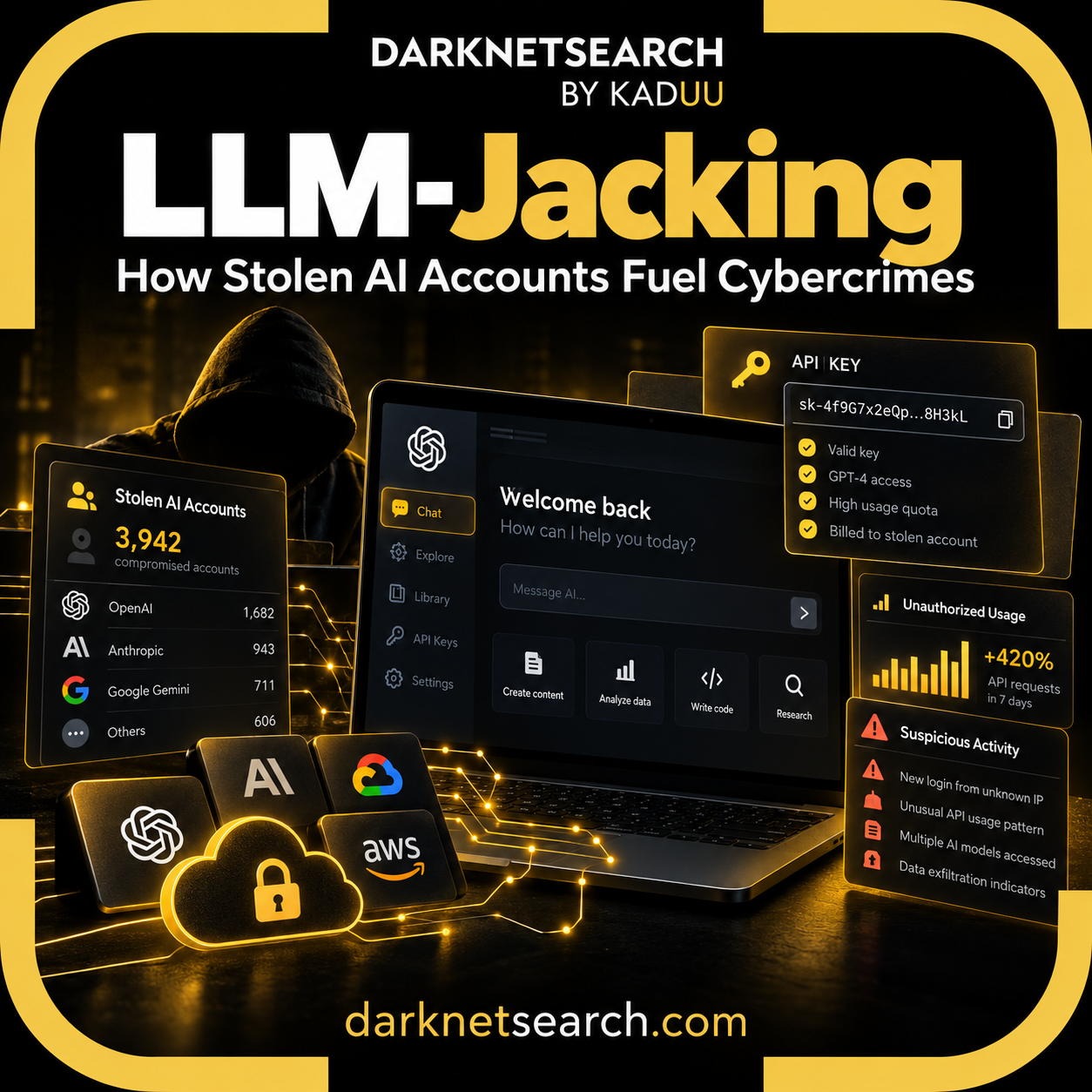
LLM-jacking is the unauthorized use of paid AI accounts, API keys, cloud credentials, or exposed model infrastructure to consume large language model resources without the owner’s permission. The immediate impact may be unauthorized inference costs, but the same access can also expose enterprise AI services, developer secrets, cloud permissions, and internal workflows to further abuse.
What Is LLM-Jacking?
LLM-jacking is a form of resource and identity abuse in which an attacker hijacks access to an organization’s large language model services or AI infrastructure. The attacker may use stolen cloud credentials, AI platform accounts, API keys, tokens, or an exposed model endpoint to run workloads while the legitimate owner absorbs the cost and risk.
The term was coined by the Sysdig Threat Research Team in 2024 after researchers observed attackers using stolen cloud credentials to reach cloud-hosted LLM services. By June 2026, Sysdig reported a further evolution: an attacker used an exposed Ollama server as the reasoning engine for an automated offensive tool, showing that the target can be either metered cloud AI or self-hosted compute. Sysdig
Google Threat Intelligence Group added another current signal on September 8, 2026. GTIG reported growing underground demand for compromised AI-related accounts, theft of AI developer credentials, and intrusions in which victim cloud environments were repurposed for unauthorized AI workloads. This makes LLM-jacking a cloud-security, identity-security, and AI-governance problem, not simply an “AI misuse” issue. Google Threat Intelligence Group’s September 2026 research Google Cloud
How Stolen AI Accounts and API Keys Enter the Attack Chain
LLM-jacking usually depends on valid access. The credential can be stolen directly from an AI service or obtained indirectly through a broader cloud or endpoint compromise.
Common exposure paths include:
- cloud credentials stolen after a server or application compromise;
- API keys committed to source repositories or configuration files;
- infostealer malware collecting browser data and developer configuration files;
- phishing or credential theft targeting AI platform accounts;
- long-lived tokens with excessive permissions;
- exposed or unauthenticated self-hosted model endpoints.
A stolen API key is not the same thing as a corporate database breach. A stealer log is also different: it is data harvested from an infected endpoint and may contain credentials, cookies, configuration files, or other secrets. DarknetSearch’s guide to stealer logs explains how endpoint-derived exposure differs from a conventional server-side breach. Darknet Search
GTIG reported in September 2026 that infostealer operators had shown interest in configuration stores used by AI coding assistants, including files that can hold plaintext API keys or custom model-routing information. That creates a direct bridge between ordinary credential theft and enterprise AI resource abuse. Google Cloud
How LLM-Jacking Is Monetized
The simplest motive is resource theft. AI inference can consume valuable cloud quotas and paid model access, so an attacker who obtains valid credentials can shift those costs to the victim.
Researchers have also documented proxy-based models in which compromised access is pooled behind a reverse proxy and then shared or resold. A newer risk is operational use: Sysdig’s June 2026 research described exposed AI compute being incorporated into an automated offensive workflow. Sysdig’s 2026 LLM-jacking research Sysdig
These cases do not mean every stolen AI account will be used for intrusion. Some may simply be abused for unpaid model access. Security teams should assess the evidence rather than assume the most severe outcome.
LLM-Jacking Is Not the Same as a Data Breach
Precise classification prevents poor incident response.
| Finding | What it means |
|---|---|
| Stolen AI account | Unauthorized access to an AI service account |
| Exposed API key | A secret that may permit API access if still valid |
| LLM-jacking | Unauthorized consumption or use of AI/model resources |
| Stealer log | Endpoint-harvested data that may contain credentials or tokens |
| Data breach | Unauthorized access to protected systems or data |
One event can lead to another, but they are not interchangeable. An API key appearing in a public repository does not prove that it was used. A credential found in a stealer log does not prove that the company’s central systems were breached.
For a practical example of why access-key exposure must be scoped carefully, DarknetSearch’s analysis of an AWS access-key incident explains how permissions and activity logs determine the actual blast radius. Darknet Search
What Security Teams Should Monitor
Defenders need visibility across identity, cloud, endpoint, and AI-service telemetry. Useful signals include:
- unexpected model invocations or token consumption;
- sudden increases in AI or cloud spend;
- API calls from unfamiliar locations or services;
- new service accounts, keys, or permission changes;
- attempts to enable additional AI services or increase quotas;
- unusual access to AI configuration files;
- endpoint alerts involving infostealer malware.
Cost anomalies deserve security review, not only finance review. A usage spike may be legitimate, but it can also indicate that a key, account, or cloud identity is being abused.
Teams should also review secret lifetime and scope. A narrowly scoped, short-lived credential limits impact more effectively than a reusable key with broad access across AI, storage, and cloud administration.
What to Do After an AI Credential Is Exposed
Response should start with containment and evidence preservation.
- Revoke or rotate the affected API key, token, password, or cloud credential.
- Revoke active sessions when the exposed identity supports session-based access.
- Review AI-service and cloud audit logs for model calls, configuration changes, quota changes, and new identities.
- Determine what the credential could access, not just what service issued it.
- Investigate the endpoint if an infostealer or local secret theft is plausible.
- Search repositories, CI/CD systems, ticketing tools, chat histories, and configuration stores for copies of the same secret.
- Correlate the finding with external exposure intelligence to determine whether related credentials or organizational data have surfaced elsewhere.
DarknetSearch provides credential leak detection for identifying exposed authentication data across monitored external sources. That visibility can support an investigation, but it does not replace cloud audit logs, EDR, IAM, or the AI provider’s own telemetry. Darknet Search
Where Dark Web and External Monitoring Fit
Not every LLM-jacking case begins on the dark web. Credentials can originate from vulnerable applications, malware infections, public repositories, phishing, or cloud misconfiguration. Criminal resale may occur through underground forums, marketplaces, private communities, or other channels.
External monitoring becomes useful when credentials, stolen data, or related indicators leave the organization’s controlled environment. The most useful workflow is correlation: external evidence shows what may be circulating outside the organization, while internal telemetry determines whether access was abused, contained, or still active.
That distinction is especially important for AI accounts because the original exposure may happen on an endpoint or inside a cloud environment long before stolen access is advertised or reused elsewhere.
Frequently Asked Questions
What is LLM-jacking?
LLM-jacking is unauthorized access to or use of an organization’s AI model resources. It commonly involves stolen cloud credentials, AI service accounts, API keys, tokens, or exposed model endpoints. The attacker uses the victim’s paid or self-hosted AI capacity for their own workloads.
Can infostealers steal AI API keys?
Yes, when keys or configuration data are stored on an infected endpoint in locations the malware can access. GTIG reported 2026 activity in which infostealer operators targeted configuration stores associated with AI coding tools. The exact exposure depends on the malware, permissions, and how the secret is stored. Google Cloud
Is an exposed API key automatically a breach?
No. Exposure means the secret may be available to an unauthorized party. A breach requires evidence of unauthorized access to protected systems or data. Teams should revoke the key, review its permissions, inspect logs, and determine whether it was actually used.
How can organizations reduce LLM-jacking risk?
Use short-lived credentials where possible, apply least privilege, keep AI endpoints authenticated, monitor model usage and spend, scan repositories for secrets, investigate infostealer infections, and rotate exposed keys quickly. AI services should be included in normal cloud identity and incident-response processes.
Strengthen Visibility Into AI Credential Exposure
LLM-jacking shows why AI infrastructure should be treated as part of the enterprise attack surface. Protecting it requires cloud IAM, secret management, endpoint security, model-usage monitoring, and rapid credential rotation. External intelligence adds another layer when stolen accounts or related data begin circulating outside the organization. DarknetSearch can support that external-visibility layer through dark web monitoring and credential exposure visibility, without replacing preventive controls.
Discover how CISOs, SOC teams, and risk leaders use our platform to detect leaks, monitor the dark web, and prevent account takeover.
🚀Explore use cases →