

➤Summary
The cybersecurity landscape faced another alarming development after an alleged breach involving ALMERYS by HEKA surfaced on the cybercrime forum Pwnforums.st on May 21, 2026. According to the threat actor known as Lagui, the compromised database reportedly contains highly sensitive personal and contractual information, including Social Security Numbers (SSNs), full names, dates of birth, phone numbers, organization names, and contract dates. 😨
The Kaduu team reportedly discovered the database during routine monitoring activities across underground communities and dark web marketplaces. While the breach has not yet been officially confirmed by ALMERYS or HEKA at the time of publication, the incident highlights the growing importance of domain exposure monitoring dark web strategies for organizations handling sensitive customer and healthcare-related information.
Cybercriminals increasingly rely on hidden forums, encrypted communication channels, and leak marketplaces to monetize stolen data. This case once again demonstrates why proactive visibility into underground ecosystems has become critical for modern enterprises. 🔍
What Happened in the Alleged ALMERYS by HEKA Database Breach
According to reports circulating on Pwnforums.st, the alleged breach was posted publicly by the threat actor Lagui on May 21, 2026. The attacker claimed to possess a database associated with ALMERYS by HEKA that allegedly contains extensive personally identifiable information (PII).
The exposed records reportedly include:
- Social Security Numbers (SSNs)
- Full names
- Dates of birth
- Phone numbers
- Organization names
- Contract dates
- Additional undisclosed internal data
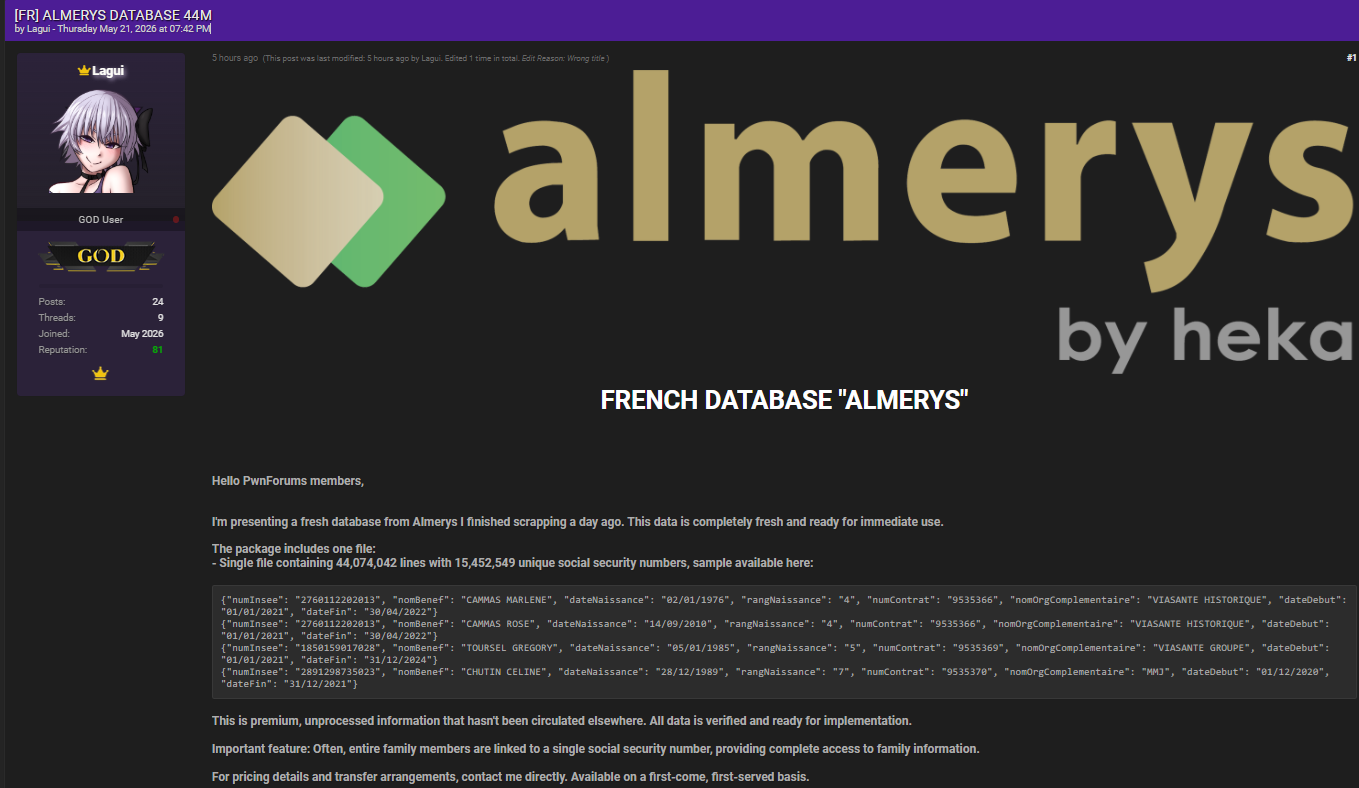
The discovery was reportedly made by the Kaduu threat monitoring team during dark web surveillance operations. Such discoveries are increasingly common as threat actors use underground communities to advertise stolen databases for sale or trade. 🕵️
Organizations that fail to maintain effective domain exposure monitoring dark web capabilities may remain unaware that their customer or employee information is actively circulating within cybercriminal ecosystems for weeks or even months.
Data Exposed and Why It Matters
The alleged leak is particularly concerning because the combination of exposed data points creates a near-complete identity profile for affected individuals.
When attackers obtain SSNs alongside names, birth dates, and phone numbers, the information can be weaponized for:
- Identity theft
- Financial fraud
- Healthcare fraud
- SIM swapping attacks
- Credential stuffing
- Social engineering campaigns
- Phishing attacks
Cybersecurity analysts frequently warn that healthcare and insurance-related data holds extremely high black-market value because it often remains useful for years. Unlike passwords, individuals cannot easily change their date of birth or Social Security Number. 😟
This incident also demonstrates how hackers use the dark web to amplify the impact of data breaches. Stolen records are often sold in bulk, repackaged into phishing kits, or merged with previously leaked datasets to enrich criminal operations.
According to research from IBM X-Force Threat Intelligence Index, personally identifiable information remains one of the most targeted asset categories in underground cybercrime markets.
Why This Alleged Breach Is Dangerous
The potential consequences extend far beyond simple data exposure. Threat actors frequently exploit leaked healthcare and insurance-related information to launch highly convincing impersonation attacks.
Here is why the alleged ALMERYS breach could become especially dangerous:
| Risk | Potential Impact |
| Identity Theft | Fraudulent loans, tax filings, and account creation |
| Healthcare Fraud | Unauthorized medical claims and insurance abuse |
| Targeted Phishing | Personalized scams using real contract details |
| Corporate Espionage | Exposure of organizational relationships |
| Account Takeovers | Credential resets using personal information |
Many companies still underestimate the importance of cybersecurity threat intelligence when evaluating breach risks. Modern attackers rarely operate alone; stolen data is rapidly distributed across ransomware affiliates, fraud groups, and access brokers. ⚠️
The emergence of sophisticated underground marketplaces means a single leaked database can fuel dozens of separate criminal campaigns.
Organizations using a reliable affordable dark web monitoring service can often detect these leaks early enough to initiate password resets, customer notifications, and incident response actions before widespread exploitation occurs.
Who Is Most at Risk? 👥
Several groups could potentially face elevated risks if the allegations prove accurate:
- Customers associated with ALMERYS services
- Employees and contractors
- Business partners
- Healthcare-related organizations
- Individuals whose contract information was included
Healthcare and insurance ecosystems are especially attractive to cybercriminals because they combine financial records, identity documents, and long-term customer relationships in centralized environments.
Question: Why do cybercriminals prioritize healthcare-related databases?
Answer: Healthcare databases often contain complete identity profiles that enable fraud, impersonation, and long-term exploitation opportunities, making them significantly more valuable than standalone credentials.
This incident also emphasizes the growing demand for dark web threat intelligence for enterprises seeking to identify compromised assets before they are weaponized.
How Hackers Use the Dark Web After Data Breaches
Understanding how hackers use the dark web helps organizations better appreciate the urgency of early detection.
Typically, the process follows several stages:
- Initial breach or unauthorized access
- Extraction of sensitive data
- Advertisement on underground forums
- Sale or exchange between criminal groups
- Secondary attacks using stolen information
Threat actors often use encrypted messaging apps, hidden Tor-based forums, and anonymous cryptocurrency payments to facilitate transactions. 😈
In many cases, exposed records are bundled into “combo lists” that support credential stuffing and phishing campaigns worldwide.
This is why continuous domain exposure monitoring dark web operations have become an essential layer of modern cyber defense strategies.
Practical Checklist for Organizations ✅
Companies concerned about similar incidents should immediately evaluate their current monitoring and response posture.
Practical cybersecurity checklist:
- Monitor underground forums for leaked assets
- Implement multi-factor authentication (MFA)
- Rotate credentials after suspected exposure
- Audit third-party vendor access
- Encrypt sensitive customer data
- Conduct regular breach simulations
- Train employees on phishing risks
- Deploy continuous cybersecurity threat intelligence solutions
A modern brand protection solution for enterprises should also include underground monitoring, credential leak detection, impersonation tracking, and real-time alerting.
The growing sophistication of cybercriminal ecosystems means reactive security approaches are no longer sufficient. 🚨
Prevention Strategies for Future Incidents
Organizations handling sensitive customer information should prioritize layered defensive measures that combine technology, visibility, and rapid response.
Key prevention strategies include:
- Continuous dark web intelligence monitoring
- Zero Trust access controls
- Vendor security assessments
- Real-time anomaly detection
- Incident response preparedness
- External attack surface management
Companies investing in domain exposure monitoring dark web solutions that also provides malicious domain detection can significantly reduce detection time for leaked assets and improve remediation speed.
Security teams should also establish formal escalation procedures whenever suspicious underground activity is identified. Early response can dramatically reduce downstream financial and reputational damage.
Why Proactive Monitoring Matters More Than Ever
The alleged ALMERYS by HEKA breach reflects a broader cybersecurity reality: organizations can no longer rely solely on perimeter defenses.
Today’s threat landscape demands visibility beyond traditional networks. Cybercriminal communities actively trade access credentials, databases, and internal documents every day across hidden ecosystems.
Proactive monitoring allows organizations to:
- Detect leaked domains early
- Monitor employee credential exposure
- Track ransomware discussions
- Identify impersonation attempts
- Reduce incident response delays
This is where specialized platforms like DarknetSearch Enterprise Monitoring play a growing role in helping companies strengthen digital risk visibility.
Conclusion
The alleged ALMERYS by HEKA database breach serves as another reminder that sensitive personal information remains one of the most valuable assets within cybercriminal markets. Whether officially confirmed or not, the exposure claims involving SSNs, names, DOBs, phone numbers, and contract details demonstrate the severe risks associated with underground data trading.
Organizations that ignore proactive monitoring may only discover breaches after customer data has already spread across multiple criminal networks. Implementing strong domain exposure monitoring dark web strategies, continuous cybersecurity threat intelligence, and rapid response protocols can dramatically improve resilience against modern cyber threats. 🔐
Is your company exposed to similar risks?
→ Start Free Trial
Discover much more in our complete guide.
Request a demo NOW.
Disclaimer:
DarknetSearch reports on publicly available threat intelligence sources. Inclusion does not imply confirmed compromise.
Discover how CISOs, SOC teams, and risk leaders use our platform to detect leaks, monitor the dark web, and prevent account takeover.
🚀Explore use cases →