

➤Summary
Cybersecurity incidents continue to expose organizations to financial and reputational risks. Dark web surveillance has become an essential capability for companies seeking to identify stolen credentials, customer information, and corporate data circulating in underground forums. 👨💻
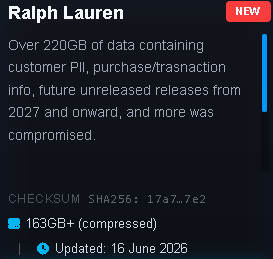
Recent discussions within cybercrime communities have raised concerns regarding an alleged Ralph Lauren database leak. Although the authenticity and scope of the incident have not been independently verified, the claims highlight why proactive monitoring and early detection are critical for enterprises.
Organizations increasingly rely on dark web intelligence to detect compromised assets before attackers exploit them further. Tools such as DarknetSearch provide visibility into potential exposure and help businesses strengthen their defensive posture. 🔐
Definition of Dark Web Surveillance
Dark web surveillance refers to the continuous monitoring of underground forums, marketplaces, messaging platforms, and hidden services where cybercriminals exchange stolen information.
Its purpose is to identify:
- Compromised credentials
- Customer records
- Corporate databases
- Leaked documents
- Exposed domains
- Malware-related activity
Unlike traditional security monitoring, dark web surveillance focuses on discovering external threats before they evolve into larger incidents.
Businesses increasingly combine these capabilities with data breach monitoring and automated dark web alerts to minimize response times.
According to the U.S. Cybersecurity and Infrastructure Security Agency (CISA), early detection and incident response significantly reduce the impact of cyberattacks.
Understanding the Alleged Ralph Lauren Database Leak
Reports circulating within cybercrime communities claim that information allegedly associated with Ralph Lauren has appeared online.
At the time of writing, there is no public confirmation regarding the authenticity of these claims. Therefore, all information should be considered unverified.
However, incidents of this nature typically involve:
| Potential Exposure | Possible Impact |
| Customer information | Identity theft |
| Email addresses | Phishing campaigns |
| Credentials | Account takeover |
| Internal records | Corporate espionage |
| Contact data | Social engineering |
Even alleged leaks can create operational challenges because threat actors often reuse or combine datasets with previously compromised information. ⚠️
How Dark Web Surveillance Works
Modern monitoring solutions operate through several stages.
1. Data Collection
Security platforms scan:
- Underground forums
- Paste sites
- Telegram channels
- Dark web marketplaces
- Hidden services
2. Correlation
The collected information is compared against:
- Corporate domains
- Employee emails
- Customer records
- Credentials
- Brand assets
3. Risk Analysis
Security teams determine:
- Severity level
- Data sensitivity
- Threat actor activity
- Exposure timeline
4. Automated Notifications
Companies receive dark web alerts when suspicious data is discovered.
5. Response and Remediation
Organizations can then:
- Reset passwords
- Enable MFA
- Notify affected users
- Investigate compromise sources
- Improve security controls
This process enables businesses to detect threats earlier and support ongoing data breach monitoring efforts. 📊
How Attackers Use Stolen Information
Cybercriminals rarely stop after obtaining data.
Instead, they monetize stolen information through various methods.
Credential Stuffing
Attackers attempt reused passwords across multiple platforms.
Phishing Campaigns
Exposed email addresses enable highly targeted scams.
Social Engineering
Personal information increases the success rate of impersonation attacks.
Financial Fraud
Leaked customer data can facilitate fraudulent transactions.
Corporate Espionage
Sensitive business information may provide competitors or criminal groups with strategic advantages.
These activities demonstrate why dark web threat intelligence for enterprises has become increasingly important. 🔎
Real-World Examples of Data Exposure
Major organizations across multiple industries have experienced cyber incidents in recent years.
Examples include:
- Retail companies
- Healthcare providers
- Financial institutions
- Telecommunications organizations
- Government agencies
Many attacks originated from:
- Credential theft
- Third-party compromise
- Misconfigured cloud environments
- Malware infections
- Insider threats
These incidents demonstrate that no sector is immune from cybercrime.
Business Risks Associated with Data Leaks
Data exposure creates consequences that extend beyond technical systems.
Financial Losses 💰
Incident response, legal fees, and remediation efforts can become extremely expensive.
Reputation Damage
Loss of customer trust can affect long-term growth.
Regulatory Penalties
Privacy regulations may require disclosure and impose fines.
Operational Disruption
Security incidents can interrupt business activities and supply chains.
Increased Phishing Threats
Attackers often exploit leaked information to launch more convincing attacks.
Organizations therefore increasingly implement domain security monitoring and phising detection capabilities alongside broader threat intelligence programs.
Why Data Breach Monitoring Matters
Data breach monitoring provides continuous visibility into compromised information.
Key benefits include:
- Faster detection
- Reduced incident impact
- Improved compliance
- Enhanced customer trust
- Better security awareness
Combined with dark web alerts, businesses gain a stronger ability to react before attackers exploit exposed information.
Continuous data breach monitoring is especially valuable for organizations managing large customer databases.
Can Companies Prevent Every Data Leak?
Question: Can businesses completely eliminate the risk of data breaches?
Answer: No.
Even mature organizations cannot guarantee complete prevention. However, continuous monitoring and rapid response can significantly reduce the impact of cyber incidents. ✅
Cybersecurity is built around risk reduction rather than absolute prevention.
Detection and Mitigation Strategies
Organizations should implement layered security controls.
Strengthen Authentication
- Use multi-factor authentication
- Enforce password policies
- Eliminate password reuse
Monitor the Dark Web
Deploy solutions that provide:
- Threat intelligence
- Automated dark web alerts
- Exposure visibility
- Incident prioritization
Train Employees
Human error remains one of the leading causes of compromise.
Regular awareness training helps reduce phishing success.
Improve Incident Response
Organizations should establish:
- Recovery procedures
- Escalation plans
- Communication protocols
Conduct Security Assessments
Routine audits help identify vulnerabilities before attackers do.
These measures support stronger data breach monitoring practices and enhance resilience. 🛡️
Practical Security Checklist
Businesses should regularly verify the following:
✅ Enable multi-factor authentication
✅ Review password policies
✅ Monitor corporate domains
✅ Investigate suspicious activity
✅ Maintain backups
✅ Educate employees
✅ Implement incident response procedures
✅ Use continuous monitoring tools
Following these practices can significantly reduce exposure to cyber threats.
Why DarknetSearch Helps Organizations Detect Exposure
DarknetSearch provides organizations with advanced monitoring capabilities designed to identify risks across underground sources.
Features include:
- Continuous dark web surveillance
- Automated dark web alerts
- Comprehensive data breach monitoring
- Threat intelligence analysis
- Exposure investigations
- Risk prioritization
Companies seeking an affordable dark web monitoring service can leverage DarknetSearch to discover compromised information and strengthen their security posture.
The platform helps security teams react quickly and improve visibility across emerging threats. 🚨
Conclusion
The alleged Ralph Lauren database leak serves as a reminder that cyber threats continue to evolve and that even unverified reports deserve attention.
Organizations that invest in dark web surveillance capabilities gain valuable visibility into external risks and can respond before attackers escalate their activities.
Combining proactive monitoring, employee awareness, incident response planning, and intelligence-driven security practices enables businesses to reduce exposure and improve resilience.
As cybercriminal ecosystems expand, continuous monitoring has become a necessity rather than an option. 🔐
See if Your Company Is Exposed:
Discover much more in our complete guide
Request a demo NOW
Disclaimer: DarknetSearch reports on publicly available threat-intelligence sources. Inclusion of an organization in an article does not imply confirmed compromise. All claims are attributed to external sources unless explicitly verified.
Discover how CISOs, SOC teams, and risk leaders use our platform to detect leaks, monitor the dark web, and prevent account takeover.
🚀Explore use cases →