
➤Summary
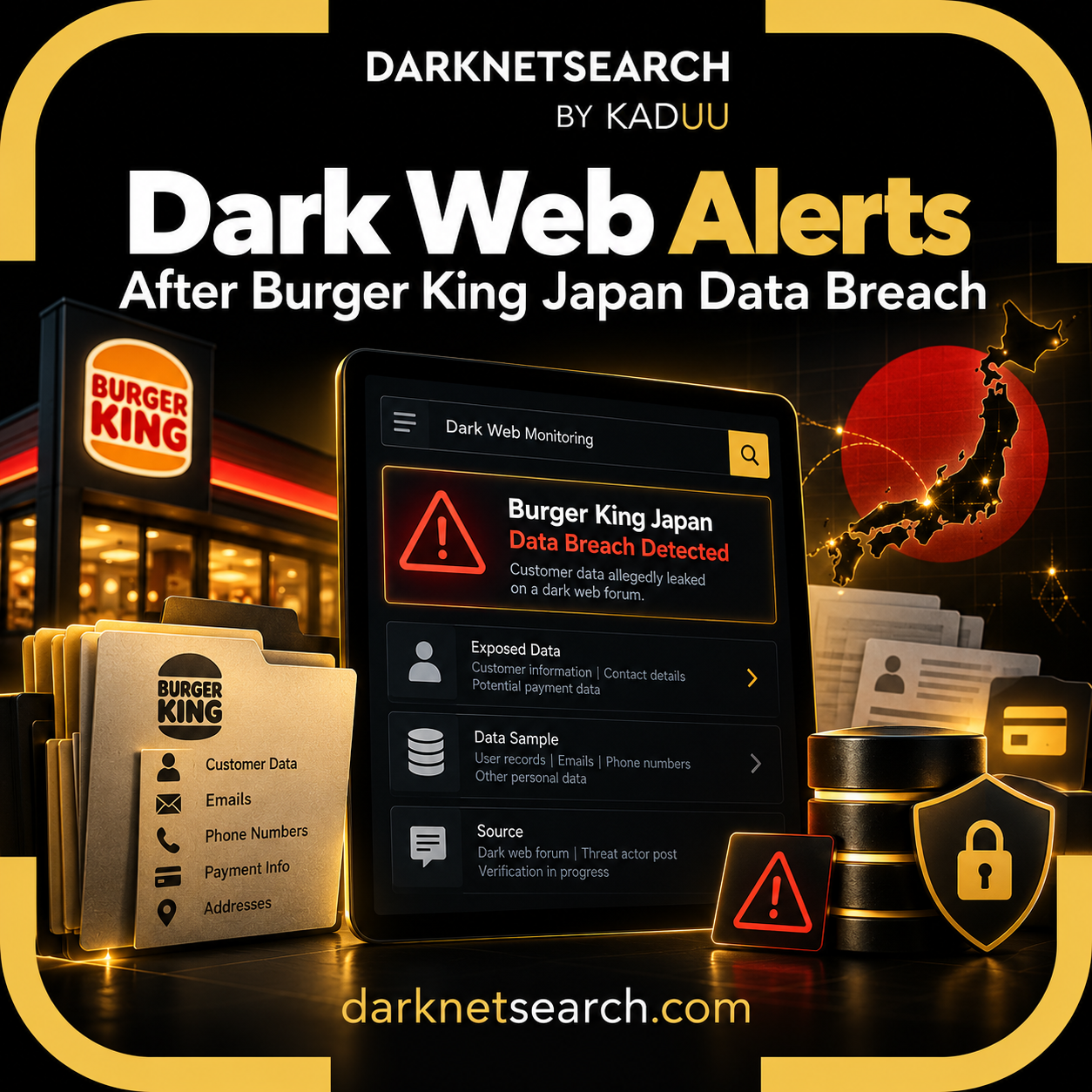
Dark web alerts can help security teams investigate potential exposure and identify follow-on threats after a data breach. Burger King Japan disclosed on October 15, 2026, that unauthorized access to its official mobile app membership system resulted in the exposure of approximately 11.18 million customer records. The incident highlights how personal information can create security risks long after an intrusion is contained.
According to reporting by BleepingComputer, the incident involved the company’s Japanese operations. The exposed information reportedly included names, email addresses, telephone numbers, dates of birth, and other membership details.
For cybersecurity teams, the incident illustrates why organizations need to investigate data exposure, monitor suspicious activity, and prepare for phishing attempts that exploit legitimate customer information.
What Happened in the Burger King Japan Data Breach?
BK Japan, the operator of Burger King in Japan, announced that an unauthorized party accessed its official application’s membership information system. The company identified the information leak on October 13 and published its notice on October 15, 2026.
The unauthorized access reportedly occurred between October 2 and October 7. The company stated that approximately 11.18 million membership records were affected. This figure represents records, not necessarily 11.18 million unique individuals.
The company said it blocked communications from the source of the unauthorized access, established an incident response structure, and continued investigating the cause with external specialists.
The incident demonstrates the importance of monitoring customer-facing applications and the systems that store personal information. Even when payment data is not involved, exposed identity details can support targeted fraud and social engineering.
What Customer Information Was Exposed?
According to the company’s published disclosure and incident reporting, the exposed membership information included:
- Member IDs
- Email addresses
- Names in Japanese kanji and kana
- Telephone numbers
- Dates of birth
- Gender
- Prefecture-level location information
- Registration type
- An indicator showing whether a member had mobile-ordering history
- An indicator showing whether an email address had been verified
The mobile-ordering indicator reportedly identified the presence or absence of ordering history, rather than revealing specific purchase details.
BK Japan stated that it did not retain credit-card numbers in the affected system and that password exposure had not been confirmed at the time of its announcement. These statements should not be interpreted as evidence that every possible form of secondary risk has been eliminated.
For the primary disclosure, consult the official Burger King Japan website, which published the company’s October 15 notice concerning the incident.
Reference: https://www.burgerking.co.jp/
Why Exposed Customer Data Creates Further Cybersecurity Risks
Personal information becomes more valuable to attackers when multiple data points can be combined. An email address alone may have limited value, but an email address linked to a person’s name, telephone number, date of birth, and membership activity can make fraudulent communications more convincing.
Targeted phishing and social engineering
Attackers may use exposed information to create messages that appear relevant to a customer’s relationship with a company. For example, a fraudulent email might claim that a loyalty account needs verification or that a mobile application reward is about to expire.
Such messages may direct recipients to fake login pages or request sensitive information. However, the existence of exposed records does not prove that attackers have already launched a phishing campaign using them.
Identity fraud and account attacks
Personal details can help criminals impersonate individuals during fraudulent customer-service interactions or other identity-verification processes. Attackers may also combine the information with data from unrelated breaches to build more complete profiles.
The reported incident does not establish that Burger King Japan account passwords were stolen. Nevertheless, security teams should investigate whether exposed email addresses overlap with previously compromised credentials or other known incidents.
Brand impersonation
A publicized breach can create opportunities for criminals to impersonate the affected organization. Fraudulent websites, email messages, text messages, and telephone calls may exploit public concern about the incident.
This is where domain monitoring and domain spoofing detection software can support a broader defensive strategy by helping identify suspicious domains that imitate a legitimate brand.
How Dark Web Alerts Support Breach Investigations
Dark web alerts notify security teams when monitored information or assets appear in relevant external sources. Depending on the monitoring service, those sources may include criminal forums, underground marketplaces, paste sites, Telegram channels, and stealer-log collections.
These sources are not interchangeable. Telegram is a messaging platform, paste sites host shared text or files, and Tor-accessible services operate within a distinct network environment. Effective intelligence collection considers each source separately.
After an incident such as the Burger King Japan breach, a monitoring program can help defenders investigate whether relevant information is circulating beyond the original exposure.
Useful monitoring targets include:
- Corporate email addresses associated with affected services
- Employee credentials that may appear in unrelated leaks
- Brand names and domains mentioned in suspicious discussions
- Newly published datasets claiming to contain customer information
- Lookalike domains that could support phishing campaigns
- Third-party services connected to the affected business
A match should not automatically be treated as proof of a new compromise. Analysts should evaluate source reliability, publication dates, record samples, duplication, and whether the information is genuinely new.
A dark web search engine for cybersecurity can help analysts search external sources for relevant indicators, while ongoing monitoring can provide continued visibility into newly discovered exposures.
What Security Teams Should Do After a Customer Data Breach
The response should connect incident investigation with identity protection, fraud prevention, and external threat monitoring.
- Validate the affected data. Confirm which records and information fields were exposed. Separate verified facts from assumptions, and document any remaining uncertainty about the scope.
- Assess identity-related risks. Determine whether exposed email addresses or other identifiers overlap with compromised employee accounts, privileged identities, or credentials found in previous incidents.
- Review authentication telemetry. Look for suspicious sign-ins, unusual account recovery activity, abnormal session behavior, and attempts to access associated systems. Prioritize accounts with elevated privileges or access to sensitive resources.
- Prepare for phishing and impersonation. Warn relevant support and security teams about potential fraudulent messages. Establish a trusted channel for customer communications and ensure staff know how to escalate suspicious reports.
- Monitor relevant external sources. Use data breach monitoring and threat intelligence to identify newly published datasets, exposed credentials, suspicious brand references, and potentially malicious domains.
- Coordinate remediation. Assign responsibility for investigation, customer communication, access control changes, and follow-up monitoring. Track actions through to completion rather than treating the initial containment step as the end of the incident.
These steps should complement established controls such as multifactor authentication, endpoint detection and response, identity security, and centralized security monitoring.
How DarknetSearch Fits Into External Threat Monitoring
DarknetSearch provides dark web and deep web monitoring, leak detection, attack surface discovery, and domain and brand protection capabilities, according to its official website.
For security teams investigating incidents, DarknetSearch’s dark web monitoring information explains the role of monitoring underground sources for exposed information. The DarknetSearch Knowledge Center also provides access to cybersecurity intelligence and breach-related reporting.
These capabilities can support the investigation of external exposure by helping analysts identify relevant data, assess potential risks, and prioritize follow-up actions. For example, an organization could monitor its corporate domains and employee identifiers for relevant appearances in external datasets.
MSSPs and MDR providers may also use external threat intelligence as an additional input when assessing client exposure and preparing recurring security reports.
However, external monitoring does not establish the root cause of an incident by itself. Nor does it replace internal forensic investigation, access-log analysis, endpoint security, or incident response. Findings must be validated and translated into actions appropriate to the organization’s environment.
Frequently Asked Questions
Did Burger King Japan expose 11 million customer records?
Burger King Japan disclosed that approximately 11.18 million membership records were affected by unauthorized access to its official application membership system. The figure refers to records, not a verified count of unique people. The reported information included names, contact details, dates of birth, and other membership fields.
Were credit-card numbers or passwords exposed?
The company stated that it did not retain credit-card numbers in the affected system and that password exposure had not been confirmed when it announced the incident. These details reflect the information available in its disclosure and should not be expanded into claims that every potential risk has been ruled out.
Can dark web alerts prevent another data breach?
Dark web alerts cannot prevent every intrusion. They can help identify exposed information and provide signals for investigation, giving security teams an opportunity to respond to risks such as compromised credentials, data circulation, and phishing. They work best alongside preventive controls, internal monitoring, and a documented incident response process.
Why should businesses use data breach monitoring?
Data breach monitoring helps organizations identify signs that business or customer information has appeared in external sources. When findings are validated and prioritized, teams can investigate compromised identities, assess third-party exposure, and respond to emerging threats. Monitoring should be part of a wider security program rather than the only method used to detect compromise.
Improve Visibility Into External Threat Exposure
The Burger King Japan incident reinforces the need to understand what information may be exposed beyond an organization’s systems. Dark web alerts and continuous threat intelligence can help security teams investigate external indicators, identify potential misuse, and prioritize defensive action.
Explore DarknetSearch to learn how dark web monitoring and external threat intelligence can complement your existing security operations. The objective is not simply to find exposed information, but to turn validated findings into timely, measurable remediation.
Disclaimer: This article is for informational and cybersecurity awareness purposes only. It is based on publicly available reporting and the company’s published disclosure available at the time of writing. Incident details may change as investigations progress. The article does not claim that all exposed records have been independently examined, that the data has been verified on criminal marketplaces, or that secondary fraud has occurred. Organizations should consult official updates and qualified incident response professionals for decisions relating to a specific incident.
Discover how CISOs, SOC teams, and risk leaders use our platform to detect leaks, monitor the dark web, and prevent account takeover.
🚀Explore use cases →