
➤Summary
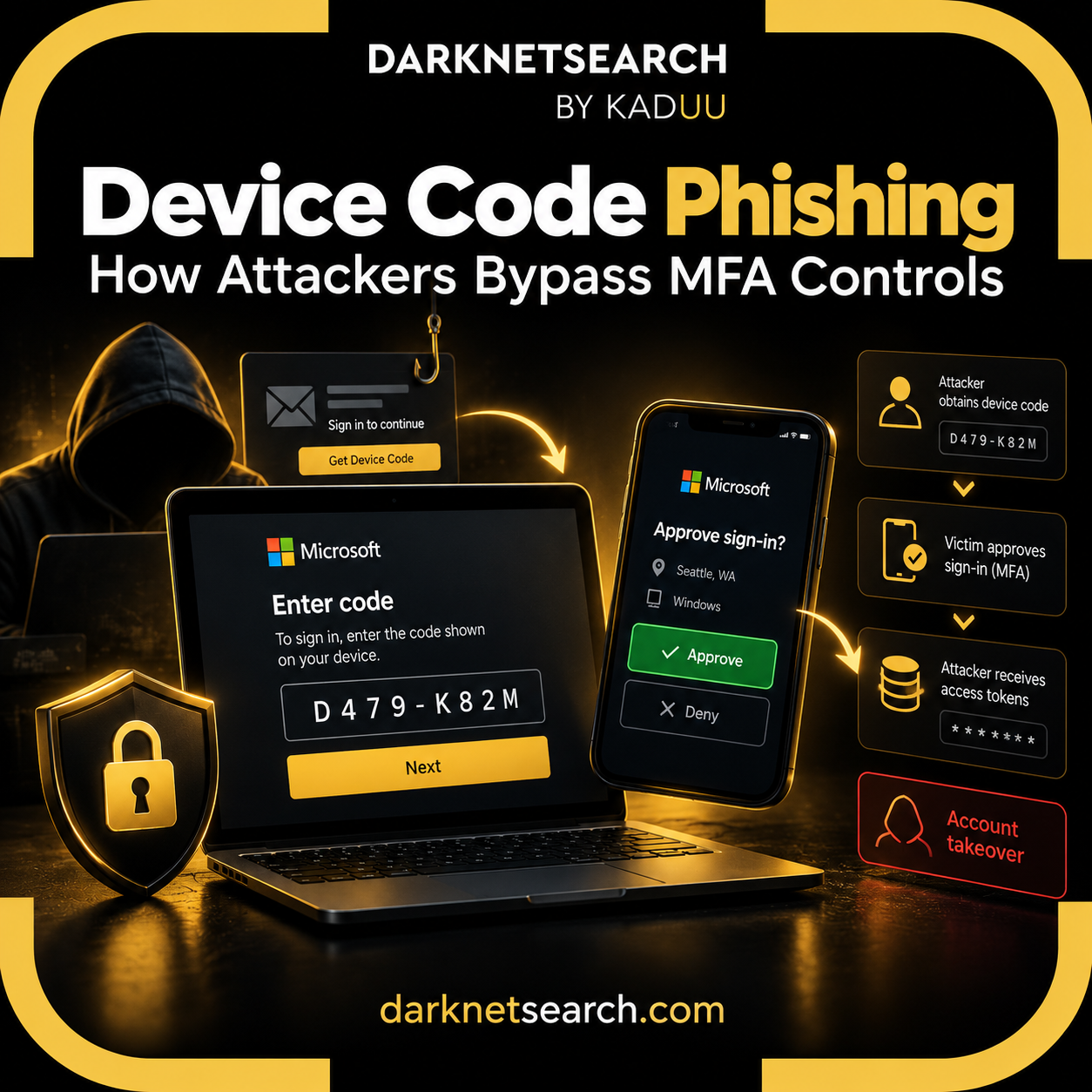
Device code phishing is an identity attack that abuses a legitimate OAuth authentication flow to obtain access tokens without requiring an attacker to capture the victim’s password. The victim may authenticate on a real Microsoft sign-in page and may even complete MFA successfully. The security failure is not that MFA is broken; it is that the user is tricked into authorizing a session the attacker initiated.
What Is Device Code Phishing?
Device code phishing abuses the OAuth 2.0 device authorization flow, a sign-in method designed for devices or applications that cannot easily display a full browser experience. A legitimate device shows a short code, and the user opens a separate browser, enters that code, signs in, and approves access.
In an attack, the attacker starts the device code flow and sends the resulting code or a lure to the victim. If the victim enters the code and completes sign-in, the identity provider can issue tokens to the attacker-controlled session.
The victim may never type a password into an attacker-owned page. The attacker can therefore obtain authenticated access without possessing the password itself.
Microsoft’s documentation on the OAuth device code flow explains that the flow is designed for input-constrained devices and that authentication takes place on a separate browser-capable device. Microsoft now allows organizations to control this higher-risk flow through Conditional Access.
How Device Code Phishing Can Get Around MFA
Calling device code phishing an “MFA bypass” can be misleading if interpreted literally. MFA may work exactly as designed. The victim can provide the required factor on Microsoft’s legitimate authentication page.
The problem is authorization context.
A simplified attack flow looks like this:
- The attacker initiates a device authorization request.
- A device code is generated for that session.
- The victim receives the code through a phishing message or deceptive page.
- The victim opens the legitimate device sign-in portal.
- The victim enters the code and authenticates, including MFA if required.
- The identity provider completes the attacker-initiated flow.
- The attacker receives access to the authorized resources.
The attacker is not necessarily defeating the second factor. Social engineering causes the user to apply it to the wrong authentication request. Microsoft has documented this behavior in device code phishing campaigns, where authentication is separated from the session that originally requested access.
Device Code Phishing vs. Credential Phishing and AiTM
Several phishing techniques can produce account takeover, but they do not work in the same way.
| Technique | What the attacker tries to obtain | Why MFA may not stop it |
|---|---|---|
| Credential phishing | Username and password | The attacker may use MFA fatigue or another second-stage technique |
| Adversary-in-the-middle phishing | Credentials plus authenticated session data | The attacker relays authentication and captures a usable session |
| Device code phishing | Authorization for an attacker-initiated device flow | The victim may complete MFA for the attacker’s session |
This distinction matters during incident response. A password reset may be necessary, but it is not sufficient if the attacker already holds valid tokens or has established additional persistence.
DarknetSearch has also examined OAuth abuse in other SaaS attack scenarios. The broader lesson is that identity incidents can involve tokens and authorized sessions rather than only stolen passwords.
Why Device Code Phishing Matters in 2026
Microsoft’s September 2026 EvilTokens investigation documented device code phishing as a core capability of a phishing platform used to automate identity compromise. Microsoft described victims being directed to the legitimate Microsoft device login page while the attacker monitored the corresponding authorization session.
Microsoft also reported that some successful compromises were followed by device registration, inbox rule creation, or Microsoft Graph activity. Those post-authentication actions give defenders useful signals beyond the original phishing message.
The technique is difficult for users to assess because parts of the experience can look trustworthy. The authentication domain can be legitimate and MFA can appear normally. The dangerous step is authorizing a code that originated from an untrusted request.
What Security Teams Should Monitor
Detection should focus on identity telemetry and events that follow authentication, not only on malicious domains.
SOC and identity teams should review:
- device code authentication events in Entra sign-in logs;
- source IP addresses and locations associated with unusual use;
- applications and resources accessed after authentication;
- new device registrations following suspicious sign-ins;
- unexpected Microsoft Graph activity;
- suspicious mailbox rules or forwarding changes;
- token or session activity outside the user’s normal pattern;
- messages or pages that instructed the user to enter a device code.
Microsoft recommends blocking device code flow where it is not needed and using Conditional Access to restrict it where legitimate use exists.
Some organizations legitimately use the flow for Teams devices, command-line tools, or other constrained environments. The goal is not to treat every event as malicious, but to identify use inconsistent with expected users, devices, applications, and locations.
How to Respond to Suspected Device Code Phishing
If device code phishing is suspected, treat it as a token and session compromise until investigation shows otherwise.
A practical response sequence is:
- Revoke active sessions and refresh tokens for the affected identity.
- Disable or restrict the account if malicious activity continues.
- Review sign-in logs to determine when the suspicious device flow began.
- Inspect device registration, application access, Graph activity, and mailbox changes.
- Remove unauthorized devices, inbox rules, or other persistence.
- Reset the password if evidence suggests credentials were also exposed.
- Review the original lure and identify other recipients.
- Restrict or block device code flow through Conditional Access where possible.
Password reset alone should not be treated as complete containment when token-based access is involved. Microsoft’s documented EvilTokens activity included post-compromise behaviors such as device registration and mailbox manipulation, which is why session and token response should accompany credential-focused actions.
Where External Exposure Monitoring Fits
Device code phishing is primarily an identity and social-engineering problem. It does not require stolen credentials to appear on the dark web, and dark web monitoring cannot replace identity logging, Conditional Access, email security, or incident response.
External visibility can still add context. A targeted user may also have credentials, session data, or endpoint-derived information exposed through unrelated channels. DarknetSearch’s guide to stealer logs explains how infostealer malware can produce datasets containing browser credentials, cookies, and other endpoint-derived information. Stealer logs are not the same thing as a device code phishing event.
Security teams should therefore correlate internal identity telemetry with external exposure intelligence rather than treating either source as complete on its own. Dark web monitoring can provide additional context when exposed identities or organizational data appear externally, while internal authentication logs establish what actually happened inside the tenant.
Frequently Asked Questions
Does device code phishing steal passwords?
Not necessarily. The victim may authenticate on the legitimate identity provider’s site, allowing the attacker to receive tokens for the attacker-initiated device flow without capturing the password. Other phishing infrastructure may still attempt credential theft, so responders should verify rather than assume the password is safe.
Can MFA stop device code phishing?
MFA helps protect identities, but it does not automatically prevent this technique. The victim may successfully complete MFA for an authorization request created by the attacker. Device-code-specific Conditional Access controls, sign-in monitoring, and rapid token revocation are important additional defenses.
Should organizations disable device code flow?
Microsoft recommends blocking device code flow wherever possible. Organizations that need it for legitimate devices or applications should scope access carefully through Conditional Access rather than leaving the flow broadly available. Microsoft Learn
Is device code phishing the same as session hijacking?
No. Session hijacking usually involves stealing or replaying an existing session artifact. Device code phishing tricks the victim into completing an attacker-initiated authorization flow, resulting in tokens being issued to that session.
Strengthen Visibility Around Identity Exposure
Device code phishing shows why identity defense must extend beyond passwords. Security teams need controls over authentication flows, strong identity telemetry, token-aware incident response, and visibility into external exposure that may provide additional context. DarknetSearch provides dark and deep web monitoring alongside external exposure capabilities, helping defenders investigate whether organizational identities or data are appearing outside their controlled environment.
Discover how CISOs, SOC teams, and risk leaders use our platform to detect leaks, monitor the dark web, and prevent account takeover.
🚀Explore use cases →