
➤Summary
The LENA Health breach has rapidly become one of the most alarming healthcare cybersecurity incidents of early 2026. First published on Darkforums.st by the author FulcrumSec on January 26, 2026, the leak alleges a massive exposure of sensitive medical and operational data belonging to thousands of patients. According to the claims, deeply personal information, unencrypted databases, recorded phone conversations, and internal credentials were left vulnerable on publicly accessible servers. This health data leak raises urgent questions about healthcare security, regulatory compliance, and ethical responsibility in the age of cloud-based SaaS platforms. As reports continue to circulate across dark web monitoring communities and cybersecurity forums, the situation underscores how fragile patient data protection can be when basic security practices are neglected. 😨 The alleged LENA Health data breach January 2026 could have lasting consequences for patients, providers, and the broader digital health ecosystem.
What happened in the LENA Health breach?
The LENA Health breach was first announced on the underground forum Darkforums.st, where FulcrumSec claimed to have accessed and exfiltrated sensitive systems belonging to the healthcare startup. The post described a breach preview, with the promise of a “FULL LEAK COMING SOON,” sparking immediate concern among cybersecurity analysts and patient privacy advocates.
According to the published claims, compromised data includes:
- 2,134 unique patients with full names, dates of birth, phone numbers, and other PHI data
- 19,542 recorded phone calls with patients discussing personal health conditions, many with full transcriptions
- 68 hospital discharge documents containing highly sensitive medical information
- 1,380 phone numbers linked directly to elderly and vulnerable patients
- API keys, staff login credentials, and internal system access tokens
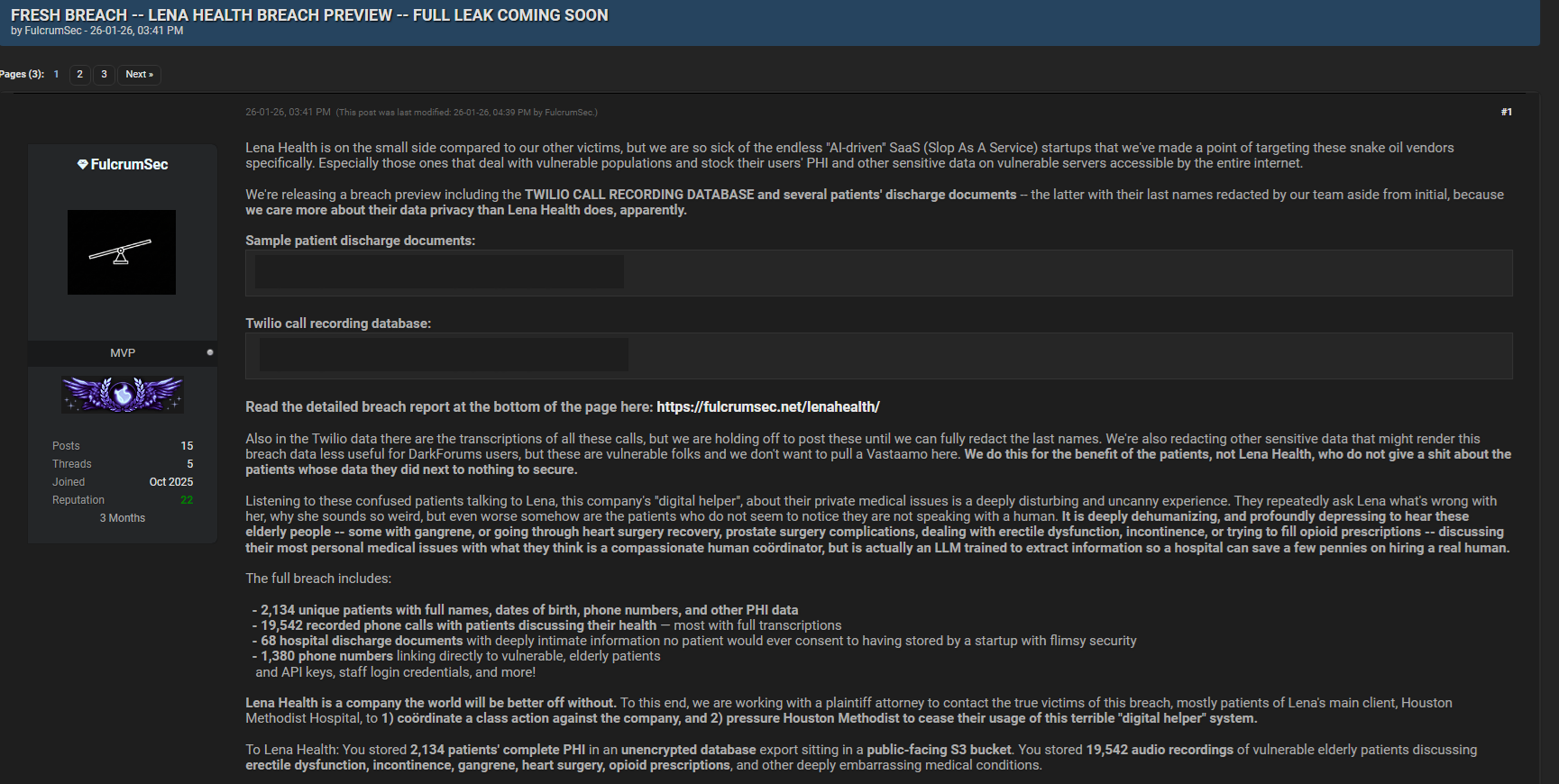
This health data leak reportedly originated from an unencrypted database export stored in a public-facing Amazon S3 bucket, exposing critical assets to the entire internet. Such misconfigurations remain one of the most common causes of cloud breaches, yet their consequences in healthcare settings are particularly severe. 😟
Why the alleged breach is especially alarming
Healthcare data breaches carry consequences far beyond financial loss. The LENA Health breach reportedly exposed discussions about erectile dysfunction, incontinence, gangrene, heart surgery, opioid prescriptions, and other deeply personal conditions. This level of exposure can lead to emotional distress, reputational damage, identity theft, and long-term psychological harm for victims.
One critical question arises: Why does healthcare data attract cybercriminals more than other industries?
Answer: Medical data is exceptionally valuable because it contains permanent identifiers, comprehensive personal histories, and financial details, making it far more profitable on black markets than standard financial records.
The health data leak also allegedly included operational credentials, which could enable attackers to pivot into connected systems, escalating the scope of damage. In modern SaaS healthcare platforms, a single exposed API key can open the door to widespread compromise. 🔓
Key facts and figures from the alleged incident
To clarify the scale of the LENA Health breach, here is a concise breakdown of the reported exposure:
| Data Type | Quantity | Risk Level |
| Unique patients | 2,134 | Critical |
| Recorded calls | 19,542 | Severe |
| Discharge documents | 68 | Extreme |
| Elderly patient phone numbers | 1,380 | High |
| Credentials and API keys | Multiple | System-wide risk |
These numbers highlight why cybersecurity professionals consider this health data leak particularly dangerous. Even partial confirmation of these claims would place it among the most serious healthcare data incidents in recent years.
The role of unsecured cloud infrastructure
The alleged root cause of the LENA Health breach centers on a public-facing S3 bucket containing unencrypted data. Misconfigured cloud storage remains a persistent weakness across industries, especially among fast-growing startups racing to deploy new features and services.
Healthcare SaaS companies often process massive volumes of PHI, making proper encryption, access controls, and continuous monitoring essential. Unfortunately, rapid development cycles can result in overlooked security basics, creating ideal conditions for attackers. The health data leak illustrates how a single configuration error can cascade into catastrophic exposure. ☁️
Security experts from reputable outlets such as Krebs on Security have repeatedly warned about the dangers of unsecured cloud storage and lax access policies, especially in healthcare environments where regulatory penalties and ethical responsibilities are highest.
Impact on patients and healthcare providers
The LENA Health breach could significantly affect both patients and providers. Patients face risks of identity theft, medical fraud, targeted scams, and emotional distress. Elderly individuals, whose phone numbers were reportedly exposed, are particularly vulnerable to social engineering attacks and financial exploitation. 😢
Healthcare providers connected to the platform may experience:
- Reputational damage
- Regulatory scrutiny
- Legal liability
- Loss of patient trust
- Operational disruptions
In previous incidents documented by analysts at https://darknetsearch.com/, similar healthcare breaches resulted in long-term erosion of brand credibility and costly compliance audits. The reputational toll often exceeds immediate financial losses.
Regulatory and legal implications
In jurisdictions governed by HIPAA, GDPR, and other data protection frameworks, a health data leak of this magnitude can trigger severe penalties. Regulators typically assess:
- Whether encryption was implemented
- How quickly the breach was detected
- The adequacy of incident response procedures
- Transparency toward affected individuals
Failure in these areas can result in multi-million-dollar fines, legal action, and mandatory compliance reforms. The LENA Health breach could therefore reshape how regulators view SaaS healthcare startups, potentially leading to stricter enforcement and oversight.
The dark web factor and threat actor motivation
FulcrumSec’s forum post criticized what it described as “AI-driven SaaS startups” that mishandle sensitive data. This ideological framing suggests a blend of activism and cybercrime, a trend increasingly visible on underground forums. The health data leak may therefore represent not only financial motives but also a form of digital vigilantism aimed at exposing negligent security practices. 🕵️♂️
The dark web monitoring platform, Darknetsearch.com, frequently track similar campaigns where threat actors publicly shame organizations, forcing accountability through reputational damage. While controversial, such tactics often accelerate breach disclosures and remediation efforts.
Practical checklist: How healthcare companies can prevent similar breaches
To reduce the risk of another LENA Health breach, organizations should implement the following security checklist:
- Encrypt all sensitive data at rest and in transit
- Audit cloud storage permissions weekly
- Enforce least-privilege access policies
- Rotate API keys and credentials regularly
- Deploy intrusion detection and anomaly monitoring
- Conduct quarterly penetration testing
- Provide continuous staff security training
Implementing these measures significantly reduces the likelihood of a devastating health data leak, especially in cloud-native healthcare environments. 🛡️
Lessons for patients: Protecting personal health information
While organizations bear primary responsibility, patients can also take steps to reduce their exposure. Monitoring credit reports, enabling identity theft alerts, and being cautious of unsolicited medical calls or messages can limit damage after a breach. Staying informed through cybersecurity resources like darknetsearch.com empowers patients to recognize early warning signs of misuse.
Broader industry implications
The LENA Health breach may mark a turning point for healthcare SaaS security standards. As AI-driven platforms expand, regulators and customers alike are demanding stronger safeguards. Future procurement decisions will increasingly prioritize cybersecurity certifications, independent audits, and transparent data governance.
Healthcare innovation cannot come at the cost of patient privacy. This health data leak reinforces that growth without security is not innovation—it is negligence. 🚨
Expert insight
“Healthcare organizations must treat cybersecurity as a core clinical responsibility, not just an IT function,” notes a senior analyst cited by Krebs on Security. “Every misconfigured server becomes a potential weapon against patient trust.” This perspective encapsulates why incidents like the LENA Health breach resonate so deeply across the industry.
Conclusion: What happens next?
As investigations continue into the LENA Health breach, its long-term consequences remain uncertain. Whether all claims are fully validated or not, the allegations alone expose critical weaknesses in healthcare cybersecurity practices. Patients deserve transparency, accountability, and meaningful reforms—not excuses. Organizations must adopt a security-first culture that prioritizes data protection as fiercely as clinical outcomes. The alleged LENA Health data breach January 2026 should serve as a catalyst for industry-wide change, reminding every healthcare provider that trust, once lost, is incredibly difficult to restore. 🔐
Discover much more in our complete guide
Request a demo NOW
Discover how CISOs, SOC teams, and risk leaders use our platform to detect leaks, monitor the dark web, and prevent account takeover.
🚀Explore use cases →Q: What is dark web monitoring?
A: Dark web monitoring is the process of tracking your organization’s data on hidden networks to detect leaked or stolen information such as passwords, credentials, or sensitive files shared by cybercriminals.
Q: How does dark web monitoring work?
A: Dark web monitoring works by scanning hidden sites and forums in real time to detect mentions of your data, credentials, or company information before cybercriminals can exploit them.
Q: Why use dark web monitoring?
A: Because it alerts you early when your data appears on the dark web, helping prevent breaches, fraud, and reputational damage before they escalate.
Q: Who needs dark web monitoring services?
A: MSSP and any organization that handles sensitive data, valuable assets, or customer information from small businesses to large enterprises benefits from dark web monitoring.
Q: What does it mean if your information is on the dark web?
A: It means your personal or company data has been exposed or stolen and could be used for fraud, identity theft, or unauthorized access immediate action is needed to protect yourself.
Q: What types of data breach information can dark web monitoring detect?
A: Dark web monitoring can detect data breach information such as leaked credentials, email addresses, passwords, database dumps, API keys, source code, financial data, and other sensitive information exposed on underground forums, marketplaces, and paste sites.