
➤Summary
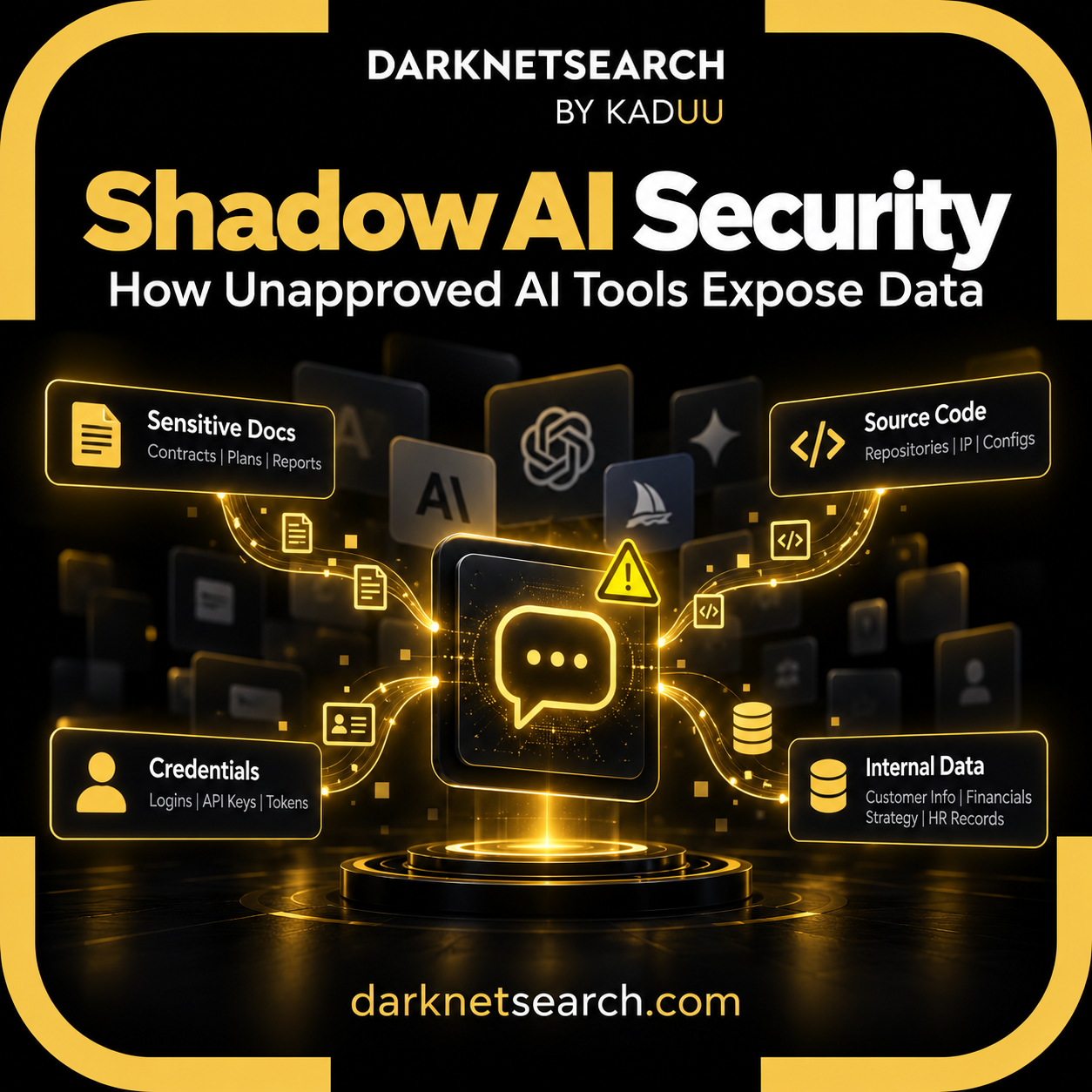
Shadow AI security addresses the risks created when employees, contractors, developers, or AI agents use artificial intelligence tools that have not been approved or governed by the organization. The core concern is losing visibility over where sensitive information goes, which identities can access it, and whether business data leaves approved controls.
What Is Shadow AI Security?
Shadow AI security is the practice of identifying and reducing risks created by unsanctioned AI applications, browser tools, coding assistants, models, and autonomous agents. The problem is visibility: security teams cannot consistently protect data, identities, and workflows when users send business information to services outside approved governance and monitoring.
This is an active enterprise-security issue in 2026. On September 23, 2026, IBM described shadow AI use inside SOC teams, including analysts pasting internal technical details into personal AI accounts. Microsoft’s September 24 security update also described controls intended to stop sensitive data from reaching shadow AI services over the network. Microsoft’s September 2026 security update
Shadow AI is therefore better understood as a governance and data-security problem with cybersecurity consequences, not as a new malware family or a single attack technique.
How Unapproved AI Tools Can Expose Company Data
The most direct risk appears when a user provides information to an AI service the organization has not reviewed. A harmless-looking prompt can carry more context than the employee realizes.
Examples include:
- source code containing internal URLs or secrets;
- customer records uploaded for summarization;
- logs containing usernames, hostnames, IP addresses, or tokens;
- contracts or spreadsheets sent for analysis;
- API responses containing keys or session information;
- screenshots showing internal dashboards;
- incident-response material shared with a personal AI account.
This does not automatically mean the information becomes public. It means the organization may no longer know which retention, access-control, contractual, or logging rules apply to that data.
Shadow AI security should focus on loss of control and visibility rather than assuming every unapproved AI interaction creates a breach.
Why Credentials, Tokens, and Source Code Need Extra Care
Some data types create disproportionate risk because they can enable access rather than simply reveal information.
A developer may paste an API request into an assistant without noticing an authorization header. A configuration file may contain an old secret. A security analyst may submit a log sample with a service-account name or internal hostname.
If a live secret crosses an unapproved trust boundary, defenders should determine whether it remains valid, what it can access, and whether it has been used unexpectedly.
DarknetSearch’s guide to the limits of traditional credential monitoring explains why exposed identity data also requires context: old credentials, reposted records, and fragmented datasets should not be treated as equivalent evidence.
Shadow AI Security Is Not the Same as a Data Breach
Several concepts are easy to blur together:
| Event | What it means |
|---|---|
| Shadow AI use | AI is used outside approved governance |
| Data leakage | Information leaves an intended boundary improperly |
| Data breach | An unauthorized party gains access to protected systems or data |
| Credential exposure | A password, token, key, or related secret becomes exposed |
| Stealer log | Data collected from an endpoint by infostealer malware |
An employee uploading internal material to an unapproved AI service may represent a policy violation or leakage risk without proving that an attacker accessed it.
Likewise, a stealer log can originate from an infected employee or contractor endpoint rather than a compromised corporate database. Precise classification matters because the response is different in each case.
How Shadow AI Expands the Attack Surface
Shadow AI security becomes harder as AI moves beyond chat interfaces. Browser extensions, coding assistants, SaaS copilots, and autonomous agents may request access to files, repositories, email, cloud services, or APIs.
Teams should inventory both AI applications and the identities and permissions attached to them:
- What data can the tool read?
- Can it write or delete information?
- Which OAuth scopes has it received?
- Does it hold API keys or service credentials?
- Can it invoke external tools?
- Are actions logged and attributable?
This is where shadow AI overlaps with identity security, SaaS governance, and non-human identity management.
An unsanctioned chatbot with no access beyond manually pasted text presents a different risk from an autonomous agent connected to email, cloud storage, source repositories, and internal APIs. Risk assessments should reflect that difference.
How to Reduce Shadow AI Risk Without Blocking Useful AI
A blanket ban may push usage further out of sight. A stronger approach is to make approved tools easy to use while controlling sensitive information.
1. Discover actual AI usage
Use network, endpoint, SaaS, browser, and identity telemetry to identify AI tools in use, including browser services, desktop apps, extensions, coding assistants, and local agents.
Microsoft’s current guidance reflects this shift toward discovering and controlling sensitive data flows to unmanaged AI services.
2. Define what must not leave approved environments
Create practical categories such as credentials, authentication tokens, customer data, source code, regulated information, incident evidence, confidential documents, and proprietary business data.
Policies work better when employees know exactly what they may and may not submit to an external model.
3. Apply identity and least-privilege controls
Review OAuth grants, service accounts, API keys, local-agent permissions, and integrations. An AI tool should not receive broad access simply because the human user already has it.
For agentic systems, teams should also understand which resources an agent can reach and whether its permissions remain appropriate as workflows change.
4. Respond quickly to exposed secrets
If someone submits a password, token, or private key to an unapproved service, treat the secret as potentially exposed. Rotate or revoke it, terminate relevant sessions where appropriate, review access logs, and investigate unexpected use.
DarknetSearch credential leak detection can support the external-visibility side of an investigation when teams need to determine whether corporate credentials appear in monitored external datasets.
5. Keep endpoint-derived exposure separate
Shadow AI and infostealer infections are different problems. If an endpoint is infected by an infostealer, browser passwords, cookies, and other data can be collected into stealer logs regardless of whether the user was using AI.
DarknetSearch provides stealer log monitoring for investigations into whether corporate identities or browser-derived access data have surfaced externally.
What External Threat Intelligence Can and Cannot Tell You
External monitoring cannot tell you every prompt an employee sent privately to an AI provider. Its value begins when evidence becomes externally observable.
Security teams may look for exposed credentials, leaked datasets, stolen secrets, threat-actor mentions, or endpoint-derived records. External threat intelligence therefore complements DLP, endpoint security, identity telemetry, SaaS governance, and internal logging.
NIST’s Generative AI Profile for the AI Risk Management Framework takes a lifecycle approach to managing generative-AI risk rather than treating it as a single technical-control problem. That framing fits shadow AI security because discovery, policy, access control, data protection, monitoring, and response all matter.
Organizations should also avoid treating every external finding as proof that shadow AI caused the exposure. A credential may originate from an unrelated breach, phishing campaign, infostealer infection, public repository, or historical credential compilation. Attribution requires evidence.
Frequently Asked Questions
What is shadow AI?
Shadow AI is the use of AI applications, models, agents, or related tools without formal approval or visibility from the organization responsible for security and governance. It can include personal chatbot accounts, browser extensions, coding assistants, SaaS AI features, or autonomous agents adopted independently by employees.
Can shadow AI cause a data breach?
It can contribute to exposure risk, but using an unapproved AI tool does not by itself prove a breach occurred. Risk depends on what information was shared, how the provider handles it, who can access it, and whether credentials or sensitive data were subsequently disclosed or misused.
What should a company do if an employee pasted an API key into an AI tool?
Assume the secret may no longer be trustworthy. Rotate or revoke it, terminate relevant sessions when appropriate, inspect authentication and application logs, determine which resources the key could access, and document the incident. Response should reflect the sensitivity and privileges of the exposed secret.
Can dark web monitoring detect shadow AI exposure?
Not directly. Dark web monitoring cannot see private prompts inside an AI service. It may help identify downstream evidence if credentials, stolen data, or related information later appears in monitored external sources. That evidence should then be correlated with internal identity, endpoint, DLP, and application telemetry.
Strengthen Visibility Around AI-Related Exposure
Shadow AI security requires visibility on both sides of the boundary: what employees and agents use internally, and whether sensitive corporate information later appears externally. Internal controls should handle discovery, access, DLP, and governance; external intelligence can support investigations when credentials or organizational data surface outside the environment. DarknetSearch can add that external perspective through dark web monitoring and external exposure visibility, without treating monitoring as a substitute for internal AI governance.
Discover how CISOs, SOC teams, and risk leaders use our platform to detect leaks, monitor the dark web, and prevent account takeover.
🚀Explore use cases →