

➤Summary
Dark web scanner intelligence is becoming increasingly relevant after the ShinyHunters extortion group claimed it breached Florida’s Driver and Vehicle Information Database, known as DAVID. According to a September 8, 2026 report from BleepingComputer, the attackers allege that they obtained more than 200,000 driver records from the Florida Department of Highway Safety and Motor Vehicles (FLHSMV) system. The claim has not been independently verified by FLHSMV or the FBI.
The incident matters because DAVID is not an ordinary public-facing database. FLHSMV describes the Driver and Vehicle Information Database as a system used by law enforcement and criminal justice officials to retrieve driver and motor vehicle information. Florida documentation also recognizes that personal information contained in motor vehicle records is subject to confidentiality protections.
For security teams, the reported incident illustrates why monitoring should extend beyond conventional endpoint and network defenses. Alleged stolen records can eventually appear across underground forums, leak sites, messaging channels, or other external sources. Continuous intelligence can help organizations identify secondary exposure and investigate whether sensitive information has moved beyond the original environment.
What Happened in the Florida DAVID Database Incident?
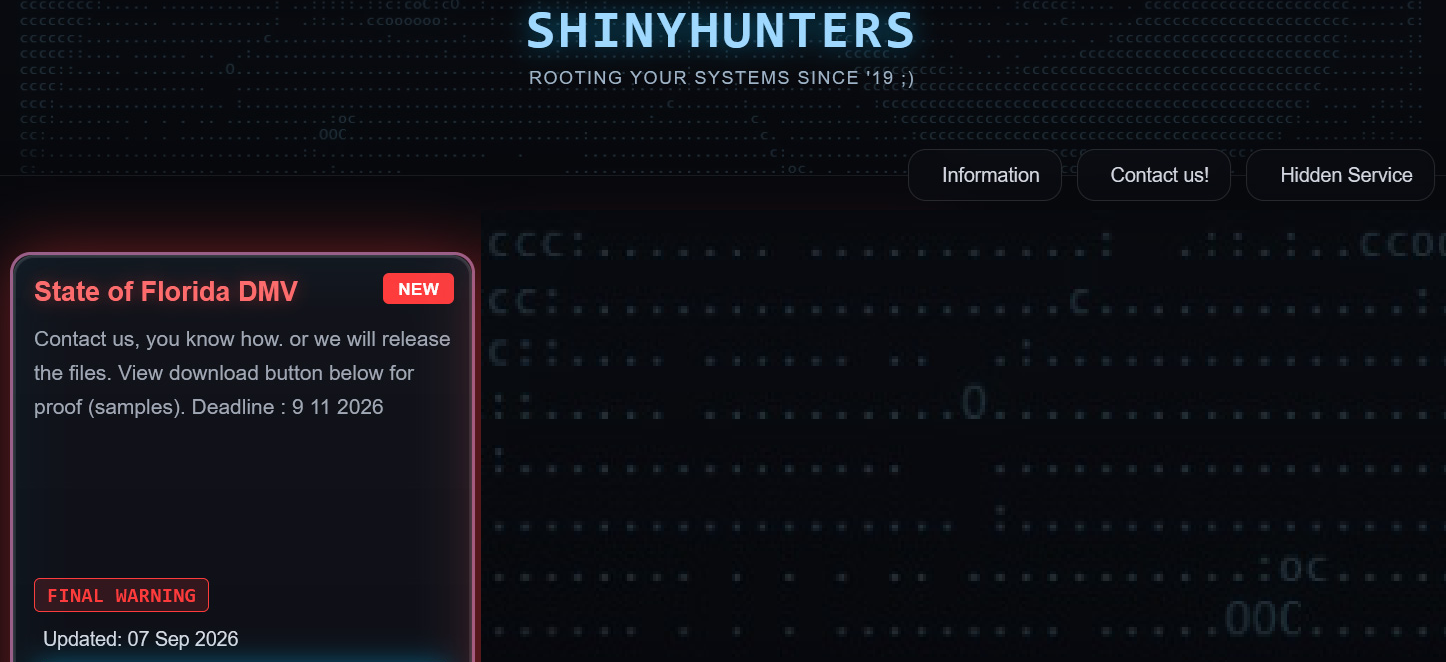
BleepingComputer reported that ShinyHunters added FLHSMV to its extortion site and threatened to release allegedly stolen information if the agency did not negotiate with the group. The attackers reportedly published a screenshot of a DAVID record as evidence of their claimed access.
According to the report, the screenshot contained highly sensitive information associated with a driver’s record, including an address, Social Security number, birth date, driver’s license identifier, license dates, and registered vehicles. BleepingComputer also reported that DAVID contains additional information such as driver’s license transactions, addresses, insurance, prior vehicles, and parking permits.
The threat actors told BleepingComputer that they allegedly gained access through what they described as a password-reset flaw. They claimed that multiple accounts were compromised, including accounts they said belonged to DMV employees and an FBI agent. They further alleged that they used the access to retrieve records by identifier and download associated HTML and image data.
These details remain attacker claims. BleepingComputer reported that the threat actors said they had subsequently lost access and that the password-reset issue was being patched. FLHSMV and the FBI had been contacted for comment at the time of publication.
What Is Confirmed and What Remains Unverified?
The distinction between an alleged breach and a confirmed compromise is essential.
The confirmed facts currently include the existence and operational role of DAVID, the public reporting of the ShinyHunters claim, the publication of alleged evidence by the threat actors, and BleepingComputer’s reporting on the group’s statements. The claimed theft of more than 200,000 records, the alleged password-reset weakness, the identities of compromised accounts, and the precise scope of data accessed should be treated as claims until independently validated.
This distinction is particularly important for organizations handling government or regulated information. Treating an attacker statement as confirmed can lead to inaccurate incident reporting, unnecessary public alarm, or incorrect assumptions about affected individuals.
FLHSMV’s own documentation shows that access to DAVID and information derived from it is subject to specific controls. Its public-records policy identifies circumstances under which information concerning DAVID access may be exempt from disclosure and emphasizes the protection of confidential information.
Why the Alleged DAVID Exposure Matters
If the attacker claims ultimately prove accurate, the potential sensitivity of the information is significant.
Driver and vehicle records can contain combinations of identity and contextual information that are valuable for fraud, impersonation, social engineering, and targeted phishing. A single exposed data element may be less useful than a correlated collection containing names, addresses, dates of birth, identification numbers, vehicle information, and other attributes.
The potential risk also extends beyond individual identity theft. Information associated with law enforcement personnel, government employees, or other sensitive individuals could potentially support highly targeted social-engineering campaigns.
Florida has previously emphasized controls around access to personal identifying information in electronic databases. Its 2021 legislative summary notes requirements concerning authorized access and use of personal identification information contained in electronic databases used by law enforcement officers.
How a Dark Web Scanner Can Help Investigate Secondary Exposure
A dark web scanner can provide an external visibility layer after an alleged database compromise. Instead of assuming that stolen information will immediately appear in one well-known marketplace, security teams can monitor a broader set of sources where threat actors communicate, advertise stolen information, publish samples, or exchange compromised data.
DarknetSearch describes its monitoring coverage as including dark web and deep web sources, criminal forums, Telegram channels, paste sites, botnet logs, and other external sources. Its dark web monitoring capabilities can therefore be considered as one component of a broader threat-intelligence workflow.
Monitoring should focus on relevant identifiers and indicators rather than indiscriminately collecting sensitive information. Security teams can look for references to organizational domains, employee accounts, known incident terminology, exposed credentials, file names, database references, and other indicators connected to an investigation.
The objective is not simply to find leaked data. It is to establish context, determine whether information is authentic, identify relationships between exposures, and provide actionable intelligence to incident-response teams.
Underground Forum Monitoring Can Reveal Follow-On Activity
Underground forum monitoring is particularly useful when an attacker claims to have stolen a large dataset but has not yet publicly released the full collection.
Threat actors may distribute samples, advertise access, discuss negotiations, publish screenshots, or move data between different communities. Monitoring these developments can help defenders distinguish between an unsupported claim and evidence that warrants escalation.
This is also where threat intelligence teams can add value through correlation. A reported dataset might contain an organization name, domain, username, email address, database terminology, or other identifier that can be connected with previous exposures.
However, an apparent match should not automatically be considered proof of the current incident. Reused datasets, historical breaches, fabricated samples, and recycled claims can create false positives. Analysts should validate timestamps, provenance, structure, consistency, and other available evidence before classifying an exposure.
What Data or Systems May Be at Risk?
Based on the attacker claims reported by BleepingComputer, the alleged exposure may involve driver and vehicle records. The report specifically describes a sample containing identity and vehicle-related information and says DAVID contains additional categories of driver information.
Potentially sensitive categories discussed in the reporting include:
- Names and identifying information
- Addresses
- Dates of birth
- Driver’s license identifiers
- License issuance and expiration information
- Social Security numbers
- Registered vehicle information
- Insurance information
- Driver’s license transaction information
- Prior vehicle information
- Parking permit information
This list should not be interpreted as a confirmed list of all data stolen. It reflects information described in the reporting and the alleged sample, while the full scope remains unverified.
Why Identity Data Creates Long-Term Risk
Unlike passwords, many identity attributes cannot simply be rotated after exposure.
An address, date of birth, vehicle association, or government-issued identifier can remain useful to criminals for extended periods. When several attributes are combined, they can strengthen impersonation attempts and social-engineering campaigns.
This makes monitoring particularly important after an alleged government database exposure. Organizations should not limit their investigation to whether a specific database dump has been published. They should also watch for downstream abuse involving exposed identities and associated credentials.
Security teams can use data breach intelligence alongside internal telemetry to identify whether information connected to their organization or personnel appears in external sources.
What Security Teams Should Do Now
Organizations investigating this incident or similar database exposure claims should prioritize evidence-based actions:
- Track official updates. Monitor statements from FLHSMV and other relevant authorities rather than relying solely on attacker communications.
- Preserve evidence. Record dates, URLs, screenshots, threat-actor statements, samples, and other intelligence relevant to the investigation.
- Identify potentially affected identities. Determine whether employees, contractors, law enforcement personnel, or other stakeholders may have information associated with the alleged exposure.
- Review authentication activity. Investigate unusual password-reset requests, account recovery events, authentication anomalies, and suspicious access patterns.
- Investigate credential exposure. Search for potentially compromised organizational accounts in external breach and stealer-log intelligence.
- Monitor for impersonation. Use typosquatting detection and brand protection capabilities to identify domains or websites attempting to exploit the incident or impersonate affected organizations.
- Coordinate incident response. Correlate external intelligence with identity, endpoint, network, and application telemetry.
- Document uncertainty. Clearly label information as confirmed, suspected, alleged, or independently verified.
The password-reset allegation is especially relevant because account recovery mechanisms can become a high-value target. Even where attackers do not retain access, organizations should examine recovery workflows, authentication logs, session activity, and account-control changes.
How the Incident Matters to MSSPs and SOC Teams
For MSSPs and managed detection teams, the reported DAVID incident demonstrates the value of combining internal security telemetry with external threat intelligence.
A SOC may see suspicious authentication behavior without knowing whether credentials have been exposed externally. Conversely, an intelligence team may identify an alleged leaked account without knowing whether that account remains active.
Correlating both sides can improve prioritization. A credential appearing in an external leak source becomes more significant when the same account shows suspicious authentication activity internally.
DarknetSearch’s existing material on dark web monitoring for MSSPs describes this broader model of using external threat intelligence to identify exposure, prioritize findings, and support client security operations.
Frequently Asked Questions
Is the Florida DAVID breach confirmed?
No. The incident is currently best described as a claimed breach. ShinyHunters told BleepingComputer that it accessed DAVID and stole more than 200,000 records, while the attackers also released an alleged sample. At the time of BleepingComputer’s September 8 report, the claims had not been independently verified by FLHSMV or the FBI.
What is the DAVID database?
DAVID stands for Driver and Vehicle Information Database. According to BleepingComputer’s review of FLHSMV information, the system is operated by Florida Highway Safety and Motor Vehicles and is used by law enforcement and criminal justice officials to retrieve driver and motor vehicle information.
Why should companies monitor underground forums after a government data breach?
Government data can contain information useful for identity fraud, impersonation, and social engineering. Underground forum monitoring can help security teams identify references, samples, credentials, or other related exposure after an incident. However, intelligence from criminal sources should be independently assessed before being treated as evidence of compromise.
Can a dark web scanner prevent a breach?
No. A dark web scanner does not replace preventive security controls such as MFA, identity security, vulnerability management, endpoint protection, logging, or incident response. Its value is visibility into external exposure. That information can help defenders investigate incidents, identify compromised credentials, and respond to threats that may otherwise remain outside the organization’s internal monitoring.
Turn External Exposure Into Actionable Intelligence
The ShinyHunters claim involving Florida’s DAVID database demonstrates why security teams need to distinguish attacker allegations from verified evidence while maintaining visibility into potential secondary exposure. Dark web monitoring can complement internal security controls by helping analysts identify leaked credentials, threat discussions, and emerging indicators connected to an investigation.
Organizations looking to strengthen their external visibility can explore DarknetSearch’s threat‑intelligence and monitoring capabilities at darknetsearch.com, using external intelligence as one layer within a broader incident‑response and cybersecurity strategy. You can also start a free trial to experience the platform firsthand.
Disclaimer: DarknetSearch reports on publicly available threat-intelligence sources. Inclusion of an organization in an article does not imply confirmed compromise. All claims are attributed to external sources unless explicitly verified.
Discover how CISOs, SOC teams, and risk leaders use our platform to detect leaks, monitor the dark web, and prevent account takeover.
🚀Explore use cases →