
➤Summary
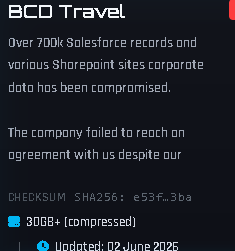
Cybercriminal groups continue to target enterprise SaaS platforms, and the latest alleged victim is BCD Travel. According to claims published by ShinyHunters, approximately 700,000 Salesforce records connected to BCD Travel were stolen and offered through underground channels.
While organizations often focus on ransomware, breaches like this can lead to equally damaging outcomes, including account takeover, business email compromise, fraud, data leakage, and financial losses. 🚨
For MSSPs, SOC teams, and enterprise security leaders, the incident highlights a growing trend: attackers increasingly exploit cloud platforms and third-party ecosystems rather than traditional network perimeters. The result is reduced visibility, faster data exfiltration, and a larger attack surface.
Organizations that fail to monitor criminal communities and exposed credentials may discover a breach only after sensitive data appears on dark web marketplaces or leak sites.
According to reports from Breach News, ShinyHunters claimed responsibility for compromising BCD Travel data involving roughly 700,000 Salesforce records, continuing a broader trend of attacks targeting Salesforce-connected environments.
What Happened in the BCD Travel Data Breach?
BCD Travel is one of the world’s largest corporate travel management companies, handling business travel operations for organizations across multiple industries.
The alleged breach surfaced after ShinyHunters posted claims that they had obtained a substantial dataset originating from BCD Travel’s Salesforce environment. The exposed information reportedly included customer and business-related records.
Although investigations and official disclosures may continue to evolve, the incident reflects a familiar pattern seen throughout recent years:
- Initial access to cloud applications
- Privilege abuse or misconfiguration exploitation
- Data extraction from CRM platforms
- Extortion or public leak threats
- Secondary attacks targeting customers and partners
Threat actors increasingly view SaaS platforms as high-value targets because they centralize customer information, business communications, and operational data.
Why This Problem Matters
Many organizations underestimate the downstream impact of CRM-related breaches.
A stolen Salesforce database is far more valuable than a simple email list. Attackers can use the information to build highly convincing phishing campaigns, launch social engineering attacks, and facilitate credential theft.
Consider this scenario:
A threat actor obtains customer contact records from a travel management platform. They then send realistic travel itinerary updates containing malicious links. Employees trust the communication because it appears connected to legitimate business travel activity.
Within hours:
- Credentials are stolen
- MFA fatigue attacks begin
- Internal accounts become compromised
- Lateral movement starts
- Sensitive corporate information is exposed
The financial consequences can be severe. 💰
For enterprises, the cost often includes:
- Incident response expenses
- Regulatory penalties
- Customer notification costs
- Business disruption
- Reputational damage
This is why proactive intelligence gathering has become essential.
How Attackers Exploit Stolen Salesforce Data
Modern threat actors rarely stop after stealing records.
Instead, they transform data into opportunities for further compromise.
Common attack paths include:
| Attack Method | Business Impact |
| Credential stuffing | Account takeover |
| Spear phishing | Initial compromise |
| Business email compromise | Financial fraud |
| Identity theft | Customer harm |
| Partner impersonation | Supply-chain attacks |
| Social engineering | Internal access |
Groups such as ShinyHunters have repeatedly demonstrated an ability to monetize stolen enterprise data through extortion, resale, and follow-on attacks. Multiple security reports have linked the group to large-scale campaigns involving Salesforce-related environments and cloud services.
This creates a dangerous reality:
Even if the original breach appears limited, exposed records can fuel attacks months later.
The Growing Importance of Underground Forum Monitoring
One of the biggest challenges for security teams is visibility.
Attackers often discuss breaches long before organizations become aware of them.
This is where underground forum monitoring becomes critical.
Threat actors frequently use:
- Data leak sites
- Criminal marketplaces
- Breach forums
- Telegram channels
- Dark web communities
Security teams that implement effective underground forum monitoring can identify leaked assets before attackers weaponize them.
Instead of learning about exposure from customers or regulators, organizations gain early warning signals.
Benefits include:
✅ Faster incident response
✅ Improved threat hunting
✅ Reduced dwell time
✅ Better executive reporting
✅ Earlier breach containment
How to Detect Exposure Before Attackers Strike
A common question security leaders ask is:
How can we identify whether our organization is exposed?
The answer is continuous monitoring.
Effective detection strategies include:
Monitor Stolen Credentials
Credential exposure remains one of the most common indicators of compromise.
Monitoring employee accounts across criminal marketplaces allows teams to identify risks before attackers exploit them.
Search Dark Web Sources
A modern dark web search engine for cybersecurity enables analysts to discover references to:
- Company domains
- Employee emails
- Exposed credentials
- Leaked databases
- Corporate documents
This visibility can dramatically reduce investigation time. 🔎
Watch for Brand Abuse
Attackers frequently impersonate trusted brands after a breach.
Strong brand abuse detection capabilities help identify:
- Phishing domains
- Fake login portals
- Impersonation campaigns
- Fraudulent websites
Conduct External Attack Surface Reviews
Organizations should regularly evaluate exposed assets and cloud services.
A comprehensive website security scanner can identify misconfigurations, vulnerable applications, and exposed services that attackers may target.
Practical Security Checklist
Security teams can immediately reduce risk by following this checklist:
✔ Enable MFA across SaaS platforms
✔ Review Salesforce permissions
✔ Audit third-party integrations
✔ Monitor credential exposure
✔ Deploy phishing-resistant authentication
✔ Track data leak sites
✔ Implement continuous underground forum monitoring
✔ Use threat intelligence to prioritize response
✔ Monitor executive accounts
✔ Conduct regular exposure assessments
Small improvements often prevent major incidents. 🛡️
Why a Threat Intelligence Platform Is Essential
The scale of modern cybercrime makes manual monitoring impossible.
Thousands of leak sites, criminal forums, and dark web communities generate new threats every day.
A modern threat intelligence platform provides:
- Continuous monitoring
- Dark web visibility
- Credential exposure alerts
- Executive risk reporting
- Threat actor tracking
- Incident prioritization
Without a centralized threat intelligence platform, security teams may miss critical indicators that could prevent a breach.
Organizations increasingly rely on a threat intelligence platform to connect external threat data with internal security operations.
The result is improved visibility, faster detection, and stronger resilience.
How DarknetSearch Helps Security Teams
DarknetSearch helps MSSPs, SOC teams, and enterprises identify threats before they become incidents.
The platform combines:
- Dark web intelligence
- Credential monitoring
- Leak site tracking
- Threat actor monitoring
- Underground forum monitoring
- Exposure detection
As one of the best dark web monitoring tools available to security professionals, DarknetSearch provides actionable intelligence instead of overwhelming analysts with raw data.
Security teams can quickly determine:
- Whether employee credentials are exposed
- If company data appears on criminal forums
- Whether threat actors are discussing the organization
- If new risks require immediate actionhttps://breachnews.com/breaches/shinyhunters-claims-bcd-travel-breach-involving-700000-salesforce-records/
This proactive approach significantly improves risk reduction and operational efficiency. 🚀
For additional breach details, see the Breach News report:
https://breachnews.com/breaches/shinyhunters-claims-bcd-travel-breach-involving-700000-salesforce-records/
Conclusion
The alleged BCD Travel breach demonstrates how valuable cloud-hosted business data has become to cybercriminals. Whether attackers exploit misconfigurations, social engineering, or compromised credentials, the outcome is the same: sensitive information enters criminal ecosystems where it can fuel phishing, fraud, account takeover, and extortion campaigns.
Organizations that rely solely on perimeter defenses are operating with limited visibility.
A proactive strategy built around threat intelligence platform capabilities, underground forum monitoring, credential exposure tracking, and dark web intelligence can significantly reduce risk and improve incident response readiness. 🔥
See if your company is exposed to stolen credentials and dark web threats
Discover much more in our complete guide
Request a demo NOW
Disclaimer: DarknetSearch reports on publicly available threat-intelligence sources. Inclusion of an organization in an article does not imply confirmed compromise. All claims are attributed to external sources unless explicitly verified.
Discover how CISOs, SOC teams, and risk leaders use our platform to detect leaks, monitor the dark web, and prevent account takeover.
🚀Explore use cases →