

➤Summary
The Genious data breach has emerged as one of the most alarming cybersecurity incidents in the Moroccan digital landscape, following a significant leak posted on Darkforums.st by the user sanitizer1878. Investigators, including SOC or Security Practitioners and senior analysts, refer to the exposed files under the emerging long-tail keyword Genious.net database leak report. Experts warn that the incident goes far beyond a typical hosting compromise, revealing deep infrastructure exposure affecting business clients, public institutions, and even Government-related online systems. ⚠️
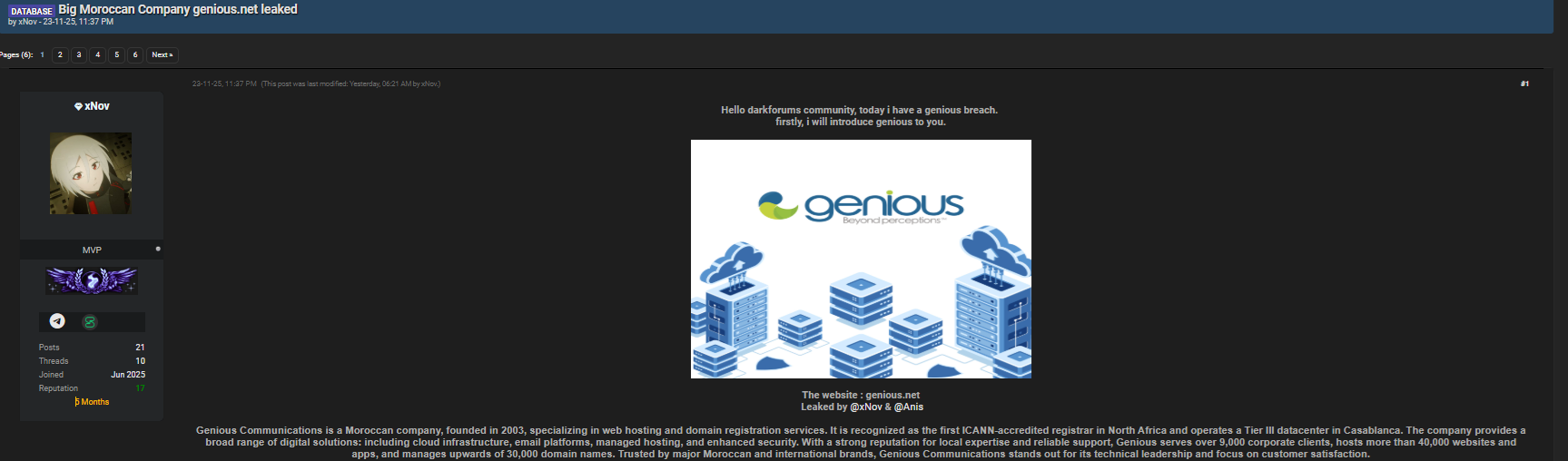
This analysis expands on the technical breach, the scale of compromised assets, and why CISOs and organizations across the region must respond urgently. With hundreds of companies depending on Genious’ hosting services, the stakes are higher than ever before.
Impact of the Dark Web Leak on Moroccan Infrastructure
Early analysis from the Kaduu team suggests attackers accessed hosting control panels, environment variables, admin roles, and highly sensitive documentation. Such data can be used to escalate privileges, hijack servers, modify DNS records, or infiltrate client databases. 🔐
SOC teams monitoring the incident warn that the leaked credentials and configuration files offer adversaries a roadmap for future attacks. The dataset reportedly contains internal architecture notes, server mapping diagrams, and client application secrets—exposing multiple operational layers.
How the Attackers Accessed and Published the Data
As security investigators review the Genious data breach, several likely attack vectors have surfaced. Threat actors may have exploited outdated cPanel or WHM dashboards, used phishing to steal employee credentials, or found misconfigured storage exposing environment variables. LSI keywords such as “infrastructure exposure,” “technical breach,” “system compromise,” “sensitive configuration files,” and “operational risk” accurately describe the situation. 🧩
Although the attacker has not publicly claimed responsibility, expert analysis suggests that the depth and diversity of files—ranging from old backup archives to recent config updates—point to persistent unauthorized access. A cybersecurity researcher provided a notable quote: “The leak contains both legacy and current documentation, which implies the intruder had prolonged access to internal systems rather than a quick penetration.”
Types of Compromised Assets Exposed in the Leak
Below is a detailed breakdown optimized for featured snippets:
- Admin credentials, API tokens, and SSH keys
- Hosting panel URLs, privilege roles, and control-panel data
- Nginx, Apache, DNS, and mail server configuration files
- Environment variable files (.env) with database passwords
- Support ticket logs, staff communications, email archives
- Client project files, source code, and integration keys
- Network architecture diagrams and provisioning manuals
This set of compromised assets intensifies concerns regarding the Moroccan hosting leak, revealing vulnerabilities not only for businesses but potentially for Government systems hosted or integrated through Genious infrastructure.
Why This Cybersecurity Incident Matters for Businesses
Companies relying on Genious services face significant risks following the Genious data breach. Attackers can now repurpose exposed configuration files to replicate client environments, explore vulnerabilities, or inject malicious code. CIOs, CISOs, and SOC or Security Practitioners are especially concerned about supply chain infiltration, DNS manipulation, and credential harvesting.
A common question arises: “Can organizations recover quickly from such deeply layered attacks?” The answer is yes—when companies take immediate action. This includes rotating all passwords, rebuilding affected services, scanning logs for unauthorized access, and applying strict MFA enforcement. 🔧
The challenge is ensuring that no dormant backdoors remain embedded. Failure to act promptly could lead to further compromise, especially for high-value targets in fintech, education, and Government digital services.
Practical Tip: Essential Checklist for Affected Users
Immediate Response Checklist:
- Rotate every admin credential and remove unused access roles
- Invalidate leaked API keys and regenerate tokens
- Rebuild environment variable files and reassign database passwords
- Scan web applications for injected backdoors
- Validate DNS records to prevent malicious redirections
- Regenerate SSL certificates for all domains
- Remove deprecated services or outdated endpoints
This checklist helps not only Genious customers but any organization facing infrastructure exposure or similar high-impact data leaks. 💡 Taking these steps promptly reduces long-term risk and prevents attackers from establishing persistence.
External and Internal Resources for Enhanced Security
For authoritative coverage of global cybersecurity events, readers can consult major platforms such as Wired, which frequently analyzes large-scale breaches and industry-shifting incidents: https://www.wired.com/.
To stay ahead of dark web activity, internal resources from DarknetSearch.com offer powerful research tools and intelligence insights:
- https://darknetsearch.com/cyber-intel
- https://darknetsearch.com/data-leaks
- https://darknetsearch.com/research
📚
Additionally, a highly relevant blog on DarknetSearch explores the behaviors of cybercriminals trading hosting infrastructure data:
👉 Recommended Blog: “How Dark Web Marketplaces Exploit Hosting Providers in 2025” — https://darknetsearch.com/research/hosting-exposure-2025
This related article helps CISOs and SOC or Security Practitioners understand how attackers evaluate hosting asset leaks, making it an ideal complement to this analysis of the Genious data breach.
Expert Commentary on the Moroccan Hosting Leak Case
The scale of the Moroccan hosting leak is deeply concerning. Analysts reviewing the dataset note that attackers obtained operational blueprints typically restricted to internal engineering teams. A Swiss cybersecurity expert commented: “This is more than a list of credentials—it’s an operational handbook for cybercriminals. Any attacker who acquires this dataset can reconstruct internal logic, dependencies, and infrastructure flows.”
The incident also raises red flags for Government bodies relying on third-party hosting. Many public-facing platforms depend on external infrastructure providers, meaning breaches like these have implications beyond commercial activity. For CISOs overseeing public sector systems, the leak serves as a direct reminder of the importance of zero-trust frameworks, encrypted documentation, and strict auditing.
Business and Industry-Wide Impact of This Dark Web Leak
The ripple effects of the Genious data breach extend across private businesses, educational institutions, fintech platforms, and Government services. Because Genious Communications maintains a large market share in Morocco’s hosting industry, this breach could lead to industry-wide audits, compliance reforms, and new cybersecurity mandates. 🛡️
For example, regulatory bodies may require hosting providers to adopt hardened access protocols, improved credential storage policies, and continuous dark web monitoring. CISOs are already recommending additional investments in endpoint protection, encrypted documentation, and vulnerability lifecycle management.
This incident may also accelerate shifts toward containerized cloud environments, reducing the risk posed by shared infrastructure—a pain point revealed by the leaked documentation.
Recovery Strategies and Long-Term Prevention
Recovering from the Genious data breach requires both immediate mitigation and long-term transformation. In the short term, companies must secure credentials, clean environments, patch vulnerabilities, and conduct deep forensic analysis. In the long term, they should redesign infrastructure diagrams, deploy WAF solutions, encrypt internal documentation, and segment production environments. 🧠
SOC or Security Practitioners emphasize the need for:
- Zero-trust authentication
- Continuous vulnerability scanning
- Privilege minimization
- Routine incident-response drills
CISOs further recommend securing supply chain components, enforcing strong code-security practices, and migrating legacy systems into modern secure cloud environments.
Key Lessons Learned From the Genious Data Breach
Key takeaways from the Genious data breach include:
- Credentials must never be stored unencrypted
- Admin dashboards need MFA and IP restrictions
- Documentation is as sensitive as passwords
- Continuous monitoring helps detect compromised endpoints early
- Hosting providers must regularly audit their server fleets
- Government services relying on third-party hosting must implement redundancy
These lessons reinforce the need for resilience and forward-thinking strategies. 🔍 Organizations that ignore these risks may face increased exposure in future dark web leak incidents.
Conclusion: Stay Proactive and Strengthen Your Cybersecurity Strategy
The Genious data breach highlights the fragility of digital ecosystems when hosting providers fail to adapt evolving security standards. With escalating threats, infrastructure exposure, and supply chain vulnerabilities, organizations must take immediate action. Whether you’re a business leader, CISO, SOC operator, or Government IT administrator, now is the time to elevate your security posture and adopt proactive monitoring solutions.
Discover much more in our complete guide
Request a demo NOW 💼
Discover how CISOs, SOC teams, and risk leaders use our platform to detect leaks, monitor the dark web, and prevent account takeover.
🚀Explore use cases →