
➤Summary
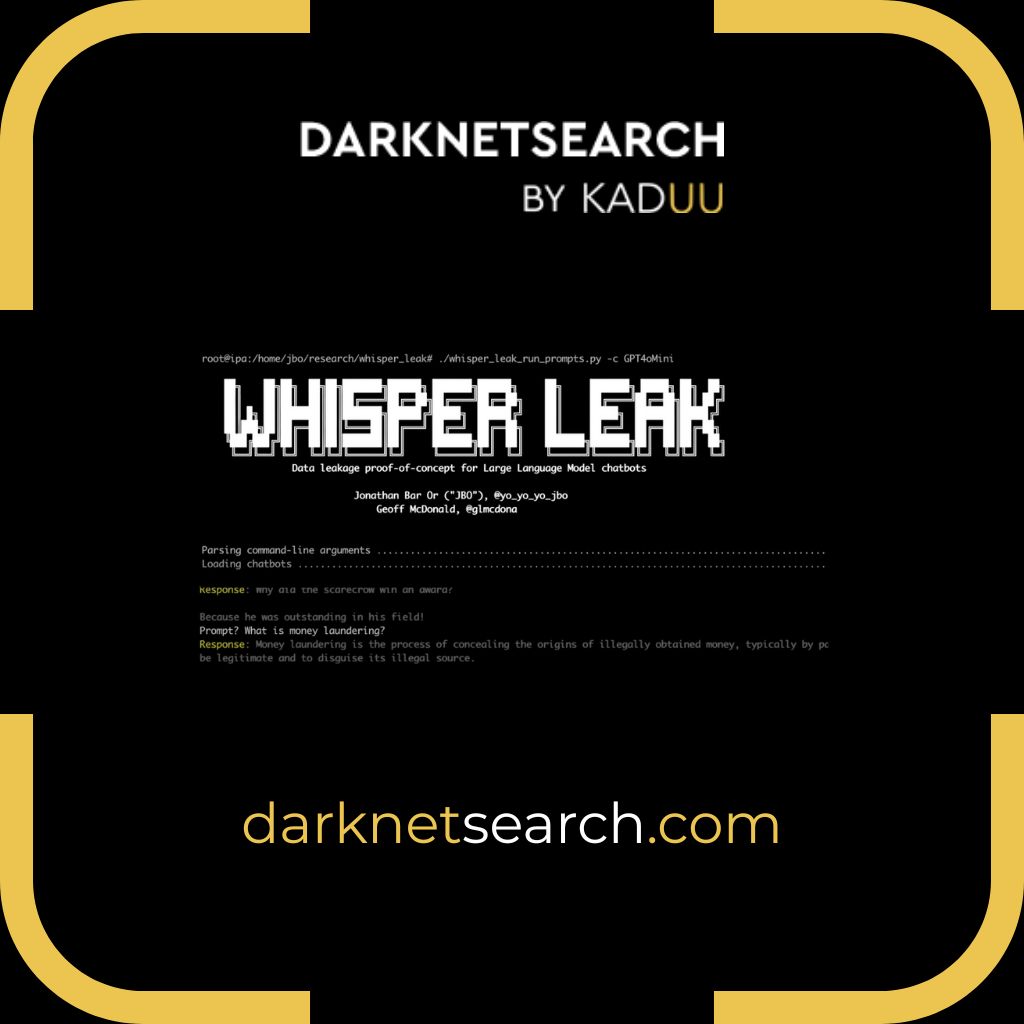
The newly uncovered Whisper-based attack is sending shockwaves through the cybersecurity and artificial intelligence world. Experts have revealed that this advanced side-channel cyberattack can secretly extract user prompts from AI traffic encryption, even when data appears fully protected. According to recent reports from Microsoft Security Blog and independent researchers, this novel threat—known as WhisperLeak—targets the subtle acoustic and timing patterns produced when large language models (LLMs) such as ChatGPT, Gemini, or Claude communicate with users. 🧠
The implications are alarming: attackers can potentially reconstruct sensitive queries or private data hidden inside encrypted AI sessions. This discovery sheds light on how Whisper leak exposes AI model prompts and challenges current assumptions about AI traffic encryption security.
Understanding the Whisper-Based Attack
At its core, the Whisper-based attack operates by analyzing side-channel information—tiny variations in sound, latency, or power consumption—during communication between a user and a remote language model. These signals, often ignored in standard cybersecurity analysis, can act as a “whisper” channel through which secrets escape unnoticed.
Researchers demonstrated that even when TLS encryption is applied, a skilled attacker could infer up to 75% of a user’s typed or spoken input based solely on these subtle cues. This makes the attack not only innovative but deeply concerning for industries using AI for healthcare, legal advice, and finance, where privacy is paramount. 🔒
The experiment showed that specific neural network architectures produce distinct audio or timing signatures when processing text, and those signatures can be decoded with machine learning mohttps://darknetsearch.com/use-cases/healthcare-industrdels trained on leaked patterns.
Why AI Traffic Encryption Isn’t Enough
For years, encryption was considered the gold standard for securing digital communication. However, AI traffic encryption only protects data in transit—it doesn’t guard against leaks through physical or behavioral signals. The Whisper-based attack exploits this gap.
Think of it like whispering in a sealed room: even if no one hears the words, the rhythm of your speech might reveal what you’re saying. Similarly, side-channel signals such as packet timing or model inference delays can betray private prompts, making encryption insufficient on its own.
👉 Practical Tip: To reduce risk, organizations should randomize inference timing and use noise injection techniques to obscure side-channel patterns.
The Mechanics Behind the Whisper Leak 🧩
So, how does Whisper leak expose AI model prompts in practice? It combines three technical layers:
- Signal Capture: The attacker monitors network or acoustic data during AI–user interaction.
- Signal Analysis: Machine learning models detect correlations between timing variations and prompt content.
- Prompt Reconstruction: The attacker uses a generative model to predict or reconstruct likely user inputs.
These steps can happen remotely, requiring no direct access to servers—just network observation. According to researchers, even encrypted HTTPS connections can leak information if model responses exhibit consistent timing patterns.
Expert Insights and Industry Reactions 🧑💻
Cybersecurity specialists describe this as a wake-up call for the AI industry. Dr. Lena Moravec, a researcher in neural network security, explains:
“The Whisper-based attack demonstrates that even strong encryption can be undermined by the physical realities of computation. It’s a reminder that data security must extend beyond software to include hardware and timing behavior.”
Microsoft’s team echoed similar concerns, calling WhisperLeak “a side-channel attack of unprecedented sophistication,” and urging developers to adopt layered security strategies.
Potential Impacts on Users and Organizations
The Whisper-based attack threatens both individuals and enterprises. For users, the risk lies in prompt exposure—private conversations with AI assistants could be partially reconstructed, revealing sensitive topics or personal identifiers. For organizations, data privacy laws such as GDPR and HIPAA may come into play, especially if AI systems handle confidential medical or legal information. ⚠️
Industries most at risk include:
- Healthcare: Patient symptoms or test results discussed with AI.
- Finance: Transaction queries or account summaries.
- Legal: Confidential case details or contract reviews.
- Education: Student performance data or academic queries.
Whisper-Based Attack vs Other Side-Channel Threats
While side-channel attacks are not new, the Whisper-based attack represents an evolution in complexity. Traditional versions—like Spectre or Meltdown—targeted CPUs and memory caches. WhisperLeak, however, focuses on AI inference processes, exploiting timing and acoustic patterns specific to neural networks.
Here’s a quick comparison:
| Attack Type | Target | Method | Risk Level |
| Spectre | CPU Caches | Speculative Execution | High |
| Meltdown | Memory Isolation | Kernel Readout | High |
| PowerSpy | Smartphone Sensors | Power Usage | Medium |
| Whisper-Based Attack | AI Models | Acoustic & Timing Leakage | Severe |
As AI becomes more integrated into critical infrastructure, these novel attack surfaces demand proactive defense strategies.
A Question Worth Asking 🤔
Could this mean AI systems will never be truly private?
Answer: Not necessarily. While the Whisper-based attack reveals serious flaws, it also accelerates innovation in AI safety. By understanding and patching these vulnerabilities early, researchers can build next-generation defenses that make future models more resilient.
The Role of AI Vendors and Developers
Vendors developing LLMs—like OpenAI, Anthropic, and Google—must prioritize language model vulnerability testing. Many experts are calling for “AI penetration testing” to become standard practice. This involves simulating side-channel attacks to identify weak points before models are deployed.
Furthermore, collaboration across the ecosystem is crucial. The report encourages open disclosure of vulnerabilities under responsible frameworks to strengthen the collective resilience of AI infrastructure. 🤝
Real-World Scenarios: When Privacy Fails
Imagine a corporate lawyer consulting an AI model for contract review. The Whisper-based attack could allow an eavesdropper to infer parts of the client’s confidential document simply by analyzing the encrypted traffic pattern. Similarly, in healthcare teleconsultations, an attacker might reconstruct fragments of patient data discussed through AI chat systems.
These examples highlight how AI traffic encryption alone cannot guarantee privacy. Only by integrating multilayered defenses can organizations safeguard users’ trust.
Future of AI Security and What’s Next
The emergence of WhisperLeak marks a new era in cybersecurity. As AI models become more complex, so do the side-channel vectors that threaten them. Experts predict a surge in “AI Shielding” technologies—tools designed to monitor and protect inference activity in real time.
In coming years, expect the rise of standards similar to ISO/IEC 27090 for AI privacy and neural network security compliance. Governments and institutions are already drafting guidelines to ensure safe AI deployment in critical sectors. 🌐
Conclusion
The Whisper-based attack is more than just another cybersecurity headline—it’s a glimpse into the next frontier of AI traffic encryption and privacy. As we continue integrating AI into our personal and professional lives, protecting prompts, data, and identities must be a top priority. The collaboration between researchers, developers, and organizations will define how secure the next generation of language models truly is. 🛡️
Ready to strengthen your defense against the next wave of side-channel attacks?
👉 Discover much more in our complete guide
👉 Request a demo NOW
Discover how CISOs, SOC teams, and risk leaders use our platform to detect leaks, monitor the dark web, and prevent account takeover.
🚀Explore use cases →